An exploration of one of the most celebrated and well-known theorems in mathematicsBy any measure, the Pythagorean theorem is the most famous statement in all of mathematics. In this book, Eli Maor re
A classic exploration of infinityIn Infinity and the Mind, Rudy Rucker leads an excursion to that stretch of the universe he calls the “Mindscape,” where he explores infinity in all its forms: potenti
How a simple equation reshaped mathematicsLeonhard Euler’s polyhedron formula describes the structure of many objects—from soccer balls and gemstones to Buckminster Fuller’s buildings and giant all-ca
More than three centuries after its creation, calculus remains a dazzling intellectual achievement and the gateway to higher mathematics. This book charts its growth and development by sampling from t
Biological evolution is a fact—but the many conflicting theories of evolution remain controversial even today. When Adaptation and Natural Selection was first published in 1966, it struck a powerful b
J. E. Gordon's classic introduction to the properties of materials used in engineering answers some fascinating and fundamental questions about how the structural world around us works. Gordon focuses
Design pervades our lives. Everything from drafting a PowerPoint presentation to planning a state-of-the-art bridge embodies this universal human activity. But what makes a great design? In this compe
What is morality? Where does it come from? And why do most of us heed its call most of the time? In Braintrust, neurophilosophy pioneer Patricia Churchland argues that morality originates in the biolo
First published in 1979, Why Big Fierce Animals Are Rare has established itself as a seminal work in ecology. Now with a new foreword by ecologist and writer Cristina Eisenberg, this penetrating study
Our universe seems strangely ''biophilic,'' or hospitable to life. Is this happenstance, providence, or coincidence? According to cosmologist Martin Rees, the answer depends on the answer to another q
Among the many constants that appear in mathematics, ?, e, and i are the most familiar. Following closely behind is y,, or gamma, a constant that arises in many mathematical areas yet maintains a prof
To Infinity and Beyond explores the idea of infinity in mathematics and art. Eli Maor examines the role of infinity, as well as its cultural impact on the arts and sciences. He evokes the profound int
Symmetry is one of the ideas by which man through the ages has tried to comprehend and create order, beauty, and perfection. Starting from the view thatsymmetry = harmony of proportions, this book gra
"It's the animal in us," we often hear when we've been bad. But why not when we're good?Primates and Philosophers tackles this question by exploring the biological foundations of one
If you think that global warming means slightly hotter weather and a modest rise in sea levels that will persist only so long as fossil fuels hold out (or until we decide to stop burning them), think
Today complex numbers have such widespread practical use--from electrical engineering to aeronautics--that few people would expect the story behind their derivation to be filled with adventure and eni
Since the publication of the first edition in 1966, Eye and Brain has established itself worldwide as an essential introduction to the basic phenomena of visual perception. Richard Gregory offers clea
The interest earned on a bank account, the arrangement of seeds in a sunflower, and the shape of the Gateway Arch in St. Louis are all intimately connected with the mysterious numbere. In this informa
Sixty-five million years ago, a comet or asteroid larger than Mount Everest slammed into the Earth, inducing an explosion equivalent to the detonation of a hundred million hydrogen bombs. Vaporized de
Einstein said that the most incomprehensible thing about the universe is that it is comprehensible. But was he right? Can the quantum theory of fields and Einstein's general theory of relativity, the
Australopithecines, dinosaurs, trilobites--such fossils conjure up images of lost worlds filled with vanished organisms. But in the full history of life, ancient animals, even the trilobites, form onl
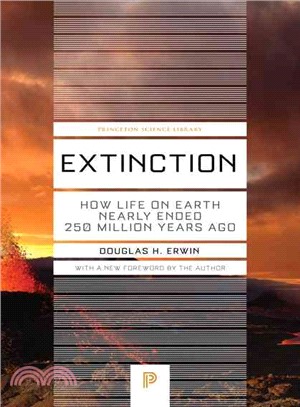
Some 250 million years ago, the earth suffered the greatest biological crisis in its history. Around 95 percent of all living species died out--a global catastrophe far greater than the dinosaurs' dem