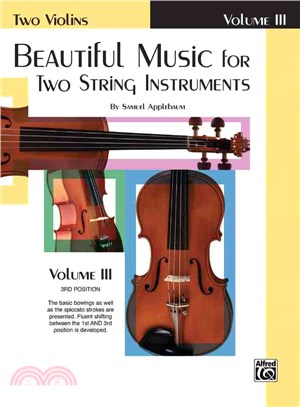
The study of string instruments should include ensemble playing at the earliest possible stage. There is much to be gained from the playing of duets. Each player learns how to listen to the other, and
The study of string instruments should include ensemble playing at the earliest possible stage. There is much to be gained from the playing of duets. Each player learns how to listen to the other, and
The Second and Fourth Position String Builder is to be used after the Third and Fifth Position String Builder. However, it is also to be used as a continuation of Book III of any of the standard strin
The Second and Fourth Position String Builder is to be used after the Third and Fifth Position String Builder. However, it is also to be used as a continuation of Book III of any of the standard strin
The Second and Fourth Position String Builder is to be used after the Third and Fifth Position String Builder. However, it is also to be used as a continuation of Book III of any of the standard strin
A collection of pieces, for Cello that were selected for their melodic beauty and architectural simplicity, making them easy to learn by rote. They may be played as solos with piano accompaniment or p
The study of string instruments should include ensemble playing at the earliest possible stage. There is much to be gained from the playing of duets. Each player learns how to listen to the other, and
The study of string instruments should include ensemble playing at the earliest possible stage. There is much to be gained from the playing of duets. Each player learns how to listen to the other, and
The Second and Fourth Position String Builder is to be used after the Third and Fifth Position String Builder. However, it is also to be used as a continuation of Book III of any of the standard strin
The study of string instruments should include ensemble playing at the earliest possible stage. There is much to be gained from the playing of duets. Each player learns how to listen to the other, and
The study of string instruments should include ensemble playing at the earliest possible stage. There is much to be gained from the playing of duets. Each player learns how to listen to the other, and
The study of string instruments should include ensemble playing at the earliest possible stage. There is much to be gained from the playing of duets. Each player learns how to listen to the other, an
The study of string instruments should include ensemble playing at the earliest possible stage. There is much to be gained from the playing of duets. Each player learns how to listen to the other, an
The study of string instruments should include ensemble playing at the earliest possible stage. There is much to be gained from the playing of duets. Each player learns how to listen to the other, an
The study of string instruments should include ensemble playing at the earliest possible stage. There is much to be gained from the playing of duets. Each player learns how to listen to the other, an
The study of string instruments should include ensemble playing at the earliest possible stage. There is much to be gained from the playing of duets. Each player learns how to listen to the other, an
The Second and Fourth Position String Builder is to be used after the Third and Fifth Position String Builder. However, it is also to be used as a continuation of Book III of any of the standard stri
First Position Etudes for Strings is written for the second year string class or string orchestra. The etudes are to be started when the string group reaches Page 10 in Volume I of the String Builder.
The pieces in this book have been selected for their musical and technical value. They have been carefully transcribed and edited to create interest in technical development and in general musicianshi
The Third and Fifth Position String Builder is to be used after Book 3 of the Belwin String Builder. However, it may also be used as a continuation of any the standard string class methods. In this bo
The pieces in this book have been selected for their musical and technical value. They have been carefully transcribed and edited to create interest in technical development and in general musicianshi
This Chamber Music book is to be started when the pupil reaches page 24 of the Samuel Applebaum String Method. However, it can be used in conjunction with any good string method. Published for two vio
Scales for Strings is to be used as supplementary material for any string class method or as interesting training material for the development of a string orchestra. The series is available in two lev
Scales for Strings is to be used as supplementary material for any string class method or as interesting training material for the development of a string orchestra. The series is available in two lev
The pieces in this book have been selected for their musical and technical value. They have been carefully transcribed and edited to create interest in technical development and in general musicianshi
Strings Are Fun is made up of program pieces which are easy to play and are full-sounding, harmonized arrangements. It can be used throughout the first year of string instrument instruction. The notes
Chamber Music for Two String Instruments, Book III is to be started when the pupil reaches page 5 of the Samuel Applebaum String Method, Book III. However, it can be used in conjunction with any other
The pieces in this book have been selected for their musical and technical value. They have been carefully transcribed and edited to create interest in technical development and in general musicianshi
The pieces in this book have been selected for their musical and technical value. They have been carefully transcribed and edited to create interest in technical development and in general musicianshi
Scales for Strings is to be used as supplementary material for any string class method or as interesting training material for the development of a string orchestra. The series is available in two lev
Chamber Music for Two String Instruments, Book III is to be started when the pupil reaches page 5 of the Samuel Applebaum String Method, Book III. However, it can be used in conjunction with any other
Chamber Music for Two String Instruments, Book III is to be started when the pupil reaches page 5 of the Samuel Applebaum String Method, Book III. However, it can be used in conjunction with any other
This Chamber Music book is to be started when the pupil reaches page 24 of the Samuel Applebaum String Method. However, it can be used in conjunction with any good string method. Published for two vio
This Chamber Music book is to be started when the pupil reaches page 24 of the Samuel Applebaum String Method. However, it can be used in conjunction with any good string method. Published for two vio
Scales for Strings is to be used as supplementary material for any string class method or as interesting training material for the development of a string orchestra. The series is available in two lev
The pieces in this book have been selected for their musical and technical value. They have been carefully transcribed and edited to create interest in technical development and in general musicianshi
The pieces in this book have been selected for their musical and technical value. They have been carefully transcribed and edited to create interest in technical development and in general musicianshi
First Position Etudes for Strings is written for the second year string class or string orchestra. The etudes are to be started when the string group reaches Page 10 in Volume I of the String Builder.