The Letters of Alciphron (second century CE) constitute one of the most attractive products of the Second Sophistic. They are fictitious compositions based on an astonishingly wide variety of circums
Cicero (Marcus Tullius, 10643 BCE), Roman lawyer, orator, politician and philosopher, of whom we know more than of any other Roman, lived through the stirring era which saw the rise, dictatorsh
Prudentius (Aurelius Prudentius Clemens) was born in 348 CE probably at Caesaraugusta (Saragossa) and lived mostly in northeastern Spain, but visited Rome between 400 and 405. His parents, presumably
Dionysius of Halicarnassus was born before 53 BCE and went to Italy before 29 BCE. He taught rhetoric in Rome while studying the Latin language, collecting material for a history of Rome, and writing
Aristotle, great Greek philosopher, researcher, reasoner, and writer, born at Stagirus in 384 BCE, was the son of a physician. He studied under Plato at Athens and taught there (367347); subseq
This volume collects the speeches of four orators involved in the ill-fated resistance of Athens to the power of Philip and Alexander the Great of Macedon.Lycurgus of Athens, ca. 396325 BCE, co
Pliny the Elder, tireless researcher and writer, is author of the encyclopedic Natural History, in 37 books, an unrivaled compendium of Roman knowledge. The contents of the books are as follows. Book
Pliny the Elder, tireless researcher and writer, is author of the encyclopedic Natural History, in 37 books, an unrivaled compendium of Roman knowledge. The contents of the books are as follows. Book
Sidonius Apollinaris, a Gallo-Roman, was born at Lugdunum (Lyon) about 430 CE. He married Papianilla, daughter of the Emperor Avitus in whose honour he recited at Rome on 1 January 456 a panegyric in
Plotinus (204/5-270 CE) was the first and greatest of Neoplatonic philosophers. His writings were edited by his disciple Porphyry, who published them many years after his master's death in six sets o
Cicero (Marcus Tullius, 10643 BCE), Roman lawyer, orator, politician and philosopher, of whom we know more than of any other Roman, lived through the stirring era which saw the rise, dictatorsh
Aelian (Claudius Aelianus), a Roman born ca. 170 CE at Praeneste, was a pupil of the rhetorician Pausanias of Caesarea, and taught and practised rhetoric. Expert in Attic Greek, he became a serious s
Aelian (Claudius Aelianus), a Roman born ca. 170 CE at Praeneste, was a pupil of the rhetorician Pausanias of Caesarea, and taught and practised rhetoric. Expert in Attic Greek, he became a serious s
Seneca, Lucius Annaeus, born at Corduba (Cordova) ca. 4 BCE, of a prominent and wealthy family, spent an ailing childhood and youth at Rome in an aunt's care. He became famous in rhetoric, philosophy
Libanius (314393 CE) was one of the last great publicists and teachers of Greek paganism. His story, as presented in his Autobiography and the Life by Eunapius, is supplemented by information f
In the Metamorphoses of ApuleiusThe Golden Ass, we have the only Latin novel which survives entire. It is truly enchanting: a delightful romance combining realism and magic.The hero, Lucius, eager to
Josephus, soldier, statesman, historian, was a Jew born at Jerusalem about 37 CE. A man of high descent, he early became learned in Jewish law and Greek literature and was a Pharisee. After pleading
The medical treatises collected under Hippocrates' name are essential sources of information about the practice of medicine in antiquity and about Greek theories concerning the human body.In the case
A professing pagan in an aggressively Christian empire, a friend of the emperor Julian and acquaintance of St. Basil, a potent spokesman for private and political causesLibanius can tell us muc
A professing pagan in an aggressively Christian empire, a friend of the emperor Julian and acquaintance of St. Basil, a potent spokesman for private and political causesLibanius can tell us muc
Chariton's Callirhoe, subtitled "Love Story in Syracuse," is the oldest extant novel. It is a fast-paced historical romance with ageless charm.Chariton narrates the adventures of a strikingly beautif
Sophocles (497/6-406 BC), the second of the three great tragedians of Athens and by common consent one of the world's greatest poets, wrote more than 120 plays. Only seven of these survive complete,
One of Athens' greatest poets, Euripides has been prized in every age for the pathos, terror, surprising plot twists, and intellectual probing of his dramatic creations. Here are four of his plays in
One of antiquity's greatest poets, Euripides (ca. 485-406 BCE) has been prized in every age for the pathos, terror, surprising plot twists, and intellectual probing of his dramatic creations. Here, i
This is the eleventh and final volume in the Loeb Classical Library’s complete edition of Hippocrates’ invaluable texts, which provide essential information about the practice of medicine in antiquity
The Loeb Classical Library series Fragmentary Republican Latin continues with oratory, an important element of Roman life from the earliest times, essential to running public affairs and for advancing
The Loeb Classical Library series Fragmentary Republican Latin continues with oratory, an important element of Roman life from the earliest times, essential to running public affairs and for advancing
The Loeb Classical Library series Fragmentary Republican Latin continues with oratory, an important element of Roman life from the earliest times, essential to running public affairs and for advancing
Livy (Titus Livius), the great Roman historian, was born at Patavium (Padua) in 64 or 59 BC, where after years in Rome he died in AD 12 or 17. Livy’s history, composed as the imperial autocracy of Aug
The Greek Anthology ('Gathering of Flowers') is the name given to a collection of about 4500 short Greek poems (called epigrams but usually not epigrammatic) by about 300 composers. To the collection
The Saturnalia, Macrobius’s encyclopedic celebration of Roman culture written in the early fifth century CE, has been prized since the Renaissance as a treasure trove of otherwise unattested lo
The Saturnalia, Macrobius’s encyclopedic celebration of Roman culture written in the early fifth century CE, has been prized since the Renaissance as a treasure trove of otherwise unattested lo
The Scriptores Historiae Augustae, or Historia Augusta, is a collection of biographies of Roman emperors, heirs, and claimants from Hadrian to Numerianus (117 284 CE). The work, which is modele
Procopius, born at Caesarea in Palestine late in the 5th century, became a lawyer. In 527 CE he was made legal adviser and secretary of Belisarius, commander against the Persians, and went with Belis
Pausanias, born probably in Lydia in Asia Minor, was a Greek of the 2nd century CE, about 120180, who travelled widely not only in Asia Minor, Palestine, Egypt and North Africa, but also in Gre
The Younger Pliny was born in 61 or 62 CE, the son of Lucius Caecilius of Comum (Como) and the Elder Pliny's sister. He was educated at home and then in Rome under Quintilian. He was at Misenum at th
Plutarch (Plutarchus), ca. 45120 CE, was born at Chaeronea in Boeotia in central Greece, studied philosophy at Athens, and, after coming to Rome as a teacher in philosophy, was given consular r
Dio Cassius (Cassius Dio), ca. 150 235 CE, was born at Nicaea in Bithynia in Asia Minor. On the death of his father (Roman governor of Cilicia) he went in 180 to Rome, entered the Senate, and u
The Greek Anthology ('Gathering of Flowers') is the name given to a collection of about 4500 short Greek poems (called epigrams but usually not epigrammatic) by about 300 composers. To the collection
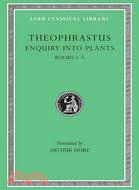
Theophrastus of Eresus in Lesbos, born about 370 BCE, is the author of the most important botanical works that have survived from classical antiquity. He was in turn student, collaborator, and succes