




滿額折
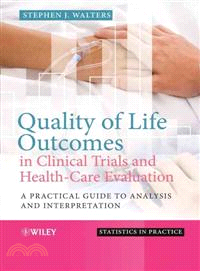
Quality Of Life Outcomes In Clinical Trials And Health-Care Evaluation - A Practical Guide To Analysis And Interpretation
商品資訊
ISBN13:9780470753828
出版社:John Wiley & Sons Inc
作者:Walters
出版日:2009/09/25
裝訂/頁數:精裝/384頁
定價
:NT$ 4216 元優惠價
:
90 折 3794 元
若需訂購本書,請電洽客服 02-25006600[分機130、131]。
商品簡介
作者簡介
名人/編輯推薦
目次
商品簡介
An essential, up-to-date guide to the design of studies and selection of the correct QoL instruments for observational studies and clinical trials.
Quality of Life (QoL) outcomes or Person/Patient Reported Outcome Measures (PROMs) are now frequently being used in randomised controlled trials (RCTs) and observational studies. This book provides a practical guide to the design, analysis and interpretation of studies that use such outcomes.
QoL outcomes tend to generate data with discrete, bounded and skewed distributions. Many investigators are concerned about the appropriateness of using standard statistical methods to analyse QoL data and want guidance on what methods to use. QoL outcomes are frequently used in cross-sectional surveys and non-randomised health-care evaluations.
* Provides a user-friendly guide to the design and analysis of clinical trials and observational studies in relation to QoL outcomes.
* Discusses the problems caused by QoL outcomes and presents intervention options to help tackle them.
* Guides the reader step-by-step through the selection of appropriate QoLs.
* Features exercises and solutions and a supporting website providing downloadable data files.
Illustrated throughout with examples and case studies drawn from the author’s experience, this book offers statisticians and clinicians guidance on choosing between the numerous available QoL instruments.
Quality of Life (QoL) outcomes or Person/Patient Reported Outcome Measures (PROMs) are now frequently being used in randomised controlled trials (RCTs) and observational studies. This book provides a practical guide to the design, analysis and interpretation of studies that use such outcomes.
QoL outcomes tend to generate data with discrete, bounded and skewed distributions. Many investigators are concerned about the appropriateness of using standard statistical methods to analyse QoL data and want guidance on what methods to use. QoL outcomes are frequently used in cross-sectional surveys and non-randomised health-care evaluations.
* Provides a user-friendly guide to the design and analysis of clinical trials and observational studies in relation to QoL outcomes.
* Discusses the problems caused by QoL outcomes and presents intervention options to help tackle them.
* Guides the reader step-by-step through the selection of appropriate QoLs.
* Features exercises and solutions and a supporting website providing downloadable data files.
Illustrated throughout with examples and case studies drawn from the author’s experience, this book offers statisticians and clinicians guidance on choosing between the numerous available QoL instruments.
作者簡介
Stephen J. Walters – School of Health and Related Research, University of Sheffield. Dr Walters has had experience both in research and teaching, and is currently the Senior Lecturer in Medical Statistics at Sheffield University. He has conducted numerous grant-funded research projects, and has nearly 150 publications to his name. These include 85 articles in a range of refereed journals, 2 co-authored books, and contributed chapters in three other books.
名人/編輯推薦
"The book covers a wide range of issues and techniques. ... Subjects are exposed clearly, with the obvious aim of being accessible to clinicians unfamiliar with mathematical formalism, and the methods are nicely illustrated with QoL data examples." (Journal of Biopharmaceutical Statistics, April 2010)
目次
Preface.
1 Introduction.
Summary.
1.1 What is quality of life?
1.2 Terminology.
1.3 History.
1.4 Types of quality of life measures.
1.5 Why measure quality of life?
1.6 Further reading.
2 Measuring quality of life.
Summary.
2.1 Introduction.
2.2 Principles of measurement scales.
2.3 Indicator and causal variables.
2.4 The traditional psychometric model.
2.5 Item response theory.
2.6 Clinimetricscal.
2.7 Measuring quality of life: indicator or causal items.
2.8 Developing and testing questionnaires.
2.9 Further reading.
3 Choosing a quality of life measure for your study.
Summary.
3.1 Introduction.
3.2 How to choose between instruments.
3.3 Appropriateness.
3.4 Acceptability.
3.5 Feasibility.
3.6 Validity.
3.7 Reliability.
3.8 Responsiveness.
3.9 Precision.
3.10 Interpretability.
3.11 Finding quality of life instruments.
4 Design and sample size issues: How many subjects do I need for my study?
Summary.
4.1 Introduction.
4.2 Significance tests, P-values and power.
4.3 Sample sizes for comparison of two independent groups.
4.4 Choice of sample size method with quality of life outcomes.
4.5 Paired data.
4.6 Equivalence/non-inferiority studies.
4.7 Unknown standard deviation and effect size.
4.8 Cluster randomized controlled trials.
4.9 Non-response.
4.10 Unequal groups.
4.11 Multiple outcomes/endpoints.
4.12 Three or more groups.
4.13 What if we are doing a survey, not a clinical trial?.
4.14 Sample sizes for reliability and method comparison studies.
4.15 Post-hoc sample size calculations.
4.16 Conclusion: Usefulness of sample size calculations.
4.17 Further reading.
5 Reliability and method comparison studies for quality of life measurements.
Summary.
5.1 Introduction.
5.2 Intra-class correlation coefficient.
5.3 Agreement between individual items on a quality of life questionnaire.
5.4 Internal consistency and Cronbach's alpha.
5.5 Graphical methods for assessing reliability or agreement between two quality of life measures or assessments.
5.6 Further reading.
5.7 Technical details.
6 Summarizing, tabulating and graphically displaying quality of life outcomes.
Summary.
6.1 Introduction.
6.2 Graphs.
6.3 Describing and summarizing quality of life data.
6.4 Presenting quality of life data and results in tables and graphs.
7 Cross-sectional analysis of quality of life outcomes.
Summary.
7.1 Introduction.
7.2 Hypothesis testing (using P-values).
7.3 Estimation (using confidence intervals).
7.4 Choosing the statistical method.
7.5 Comparison of two independent groups.
7.6 Comparing more than two groups.
7.7 Two groups of paired observations.
7.8 The relationship between two continuous variables.
7.9 Correlation.
7.10 Regression.
7.11 Multiple regression.
7.12 Regression or correlation?.
7.13 Parametric versus non-parametric methods.
7.14 Technical details: Checking the assumptions for a linear regression analysis.
8 Randomized controlled trials.
Summary.
8.1 Introduction.
8.2 Randomized controlled trials.
8.3 Protocols.
8.4 Pragmatic and explanatory trials.
8.5 Intention-to-treat and per-protocol analyses.
8.6 Patient flow diagram.
8.7 Comparison of entry characteristics.
8.8 Incomplete data.
8.9 Main analysis.
8.10 Interpretation of changes/differences in quality of life scores.
8.11 Superiority and equivalence trials.
8.12 Adjusting for other variables.
8.13 Three methods of analysis for pre-test/post-test control group designs.
8.14 Cross-over trials.
8.15 Factorial trials.
8.16 Cluster randomized controlled trials.
8.17 Further reading.
9 Exploring and modelling longitudinal quality of life data.
Summary.
9.1 Introduction.
9.2 Summarizing, tabulating and graphically displaying repeated QoL assessments.
9.3 Time-by-time analysis.
9.4 Response feature analysis – the use of summary measures.
9.5 Modelling of longitudinal data.
9.6 Conclusions.
10 Advanced methods for analysing quality of life outcomes.
Summary.
10.1 Introduction.
10.2 Bootstrap methods.
10.3 Bootstrap methods for confidence interval estimation.
10.4 Ordinal regression.
10.5 Comparing two independent groups: Ordinal quality of life measures (with less than 7 categories).
10.6 Proportional odds or cumulative logit model.
10.7 Continuation ratio model.
10.8 Stereotype logistic model.
10.9 Conclusions and further reading.
11 Economic evaluations.
Summary.
11.1 Introduction.
11.2 Economic evaluations.
11.3 Utilities and QALYs.
11.4 Economic evaluations alongside a controlled trial.
11.5 Cost-effectiveness analysis.
11.6 Cost–effectiveness ratios.
11.7 Cost–utility analysis and cost–utility ratios.
11.8 Incremental cost per QALY.
11.9 The problem of negative (and positive) incremental cost–effectiveness ratios.
11.10 Cost-effectiveness acceptability curves.
11.11 Further reading.
12 Meta-analysis.
Summary.
12.1 Introduction.
12.2 Planning a meta-analysis.
12.3 Statistical methods in meta-analysis.
12.4 Presentation of results.
12.5 Conclusion.
12.6 Further reading.
13 Practical issues.
Summary.
13.1 Missing data.
13.2 Multiplicity, multi-dimensionality and multiple quality of life outcomes.
13.3 Guidelines for reporting quality of life studies.
Solutions to exercises.
Appendix A: Examples of questionnaires.
Appendix B: Statistical tables.
References.
Index.
1 Introduction.
Summary.
1.1 What is quality of life?
1.2 Terminology.
1.3 History.
1.4 Types of quality of life measures.
1.5 Why measure quality of life?
1.6 Further reading.
2 Measuring quality of life.
Summary.
2.1 Introduction.
2.2 Principles of measurement scales.
2.3 Indicator and causal variables.
2.4 The traditional psychometric model.
2.5 Item response theory.
2.6 Clinimetricscal.
2.7 Measuring quality of life: indicator or causal items.
2.8 Developing and testing questionnaires.
2.9 Further reading.
3 Choosing a quality of life measure for your study.
Summary.
3.1 Introduction.
3.2 How to choose between instruments.
3.3 Appropriateness.
3.4 Acceptability.
3.5 Feasibility.
3.6 Validity.
3.7 Reliability.
3.8 Responsiveness.
3.9 Precision.
3.10 Interpretability.
3.11 Finding quality of life instruments.
4 Design and sample size issues: How many subjects do I need for my study?
Summary.
4.1 Introduction.
4.2 Significance tests, P-values and power.
4.3 Sample sizes for comparison of two independent groups.
4.4 Choice of sample size method with quality of life outcomes.
4.5 Paired data.
4.6 Equivalence/non-inferiority studies.
4.7 Unknown standard deviation and effect size.
4.8 Cluster randomized controlled trials.
4.9 Non-response.
4.10 Unequal groups.
4.11 Multiple outcomes/endpoints.
4.12 Three or more groups.
4.13 What if we are doing a survey, not a clinical trial?.
4.14 Sample sizes for reliability and method comparison studies.
4.15 Post-hoc sample size calculations.
4.16 Conclusion: Usefulness of sample size calculations.
4.17 Further reading.
5 Reliability and method comparison studies for quality of life measurements.
Summary.
5.1 Introduction.
5.2 Intra-class correlation coefficient.
5.3 Agreement between individual items on a quality of life questionnaire.
5.4 Internal consistency and Cronbach's alpha.
5.5 Graphical methods for assessing reliability or agreement between two quality of life measures or assessments.
5.6 Further reading.
5.7 Technical details.
6 Summarizing, tabulating and graphically displaying quality of life outcomes.
Summary.
6.1 Introduction.
6.2 Graphs.
6.3 Describing and summarizing quality of life data.
6.4 Presenting quality of life data and results in tables and graphs.
7 Cross-sectional analysis of quality of life outcomes.
Summary.
7.1 Introduction.
7.2 Hypothesis testing (using P-values).
7.3 Estimation (using confidence intervals).
7.4 Choosing the statistical method.
7.5 Comparison of two independent groups.
7.6 Comparing more than two groups.
7.7 Two groups of paired observations.
7.8 The relationship between two continuous variables.
7.9 Correlation.
7.10 Regression.
7.11 Multiple regression.
7.12 Regression or correlation?.
7.13 Parametric versus non-parametric methods.
7.14 Technical details: Checking the assumptions for a linear regression analysis.
8 Randomized controlled trials.
Summary.
8.1 Introduction.
8.2 Randomized controlled trials.
8.3 Protocols.
8.4 Pragmatic and explanatory trials.
8.5 Intention-to-treat and per-protocol analyses.
8.6 Patient flow diagram.
8.7 Comparison of entry characteristics.
8.8 Incomplete data.
8.9 Main analysis.
8.10 Interpretation of changes/differences in quality of life scores.
8.11 Superiority and equivalence trials.
8.12 Adjusting for other variables.
8.13 Three methods of analysis for pre-test/post-test control group designs.
8.14 Cross-over trials.
8.15 Factorial trials.
8.16 Cluster randomized controlled trials.
8.17 Further reading.
9 Exploring and modelling longitudinal quality of life data.
Summary.
9.1 Introduction.
9.2 Summarizing, tabulating and graphically displaying repeated QoL assessments.
9.3 Time-by-time analysis.
9.4 Response feature analysis – the use of summary measures.
9.5 Modelling of longitudinal data.
9.6 Conclusions.
10 Advanced methods for analysing quality of life outcomes.
Summary.
10.1 Introduction.
10.2 Bootstrap methods.
10.3 Bootstrap methods for confidence interval estimation.
10.4 Ordinal regression.
10.5 Comparing two independent groups: Ordinal quality of life measures (with less than 7 categories).
10.6 Proportional odds or cumulative logit model.
10.7 Continuation ratio model.
10.8 Stereotype logistic model.
10.9 Conclusions and further reading.
11 Economic evaluations.
Summary.
11.1 Introduction.
11.2 Economic evaluations.
11.3 Utilities and QALYs.
11.4 Economic evaluations alongside a controlled trial.
11.5 Cost-effectiveness analysis.
11.6 Cost–effectiveness ratios.
11.7 Cost–utility analysis and cost–utility ratios.
11.8 Incremental cost per QALY.
11.9 The problem of negative (and positive) incremental cost–effectiveness ratios.
11.10 Cost-effectiveness acceptability curves.
11.11 Further reading.
12 Meta-analysis.
Summary.
12.1 Introduction.
12.2 Planning a meta-analysis.
12.3 Statistical methods in meta-analysis.
12.4 Presentation of results.
12.5 Conclusion.
12.6 Further reading.
13 Practical issues.
Summary.
13.1 Missing data.
13.2 Multiplicity, multi-dimensionality and multiple quality of life outcomes.
13.3 Guidelines for reporting quality of life studies.
Solutions to exercises.
Appendix A: Examples of questionnaires.
Appendix B: Statistical tables.
References.
Index.










購物須知
外文書商品之書封,為出版社提供之樣本。實際出貨商品,以出版社所提供之現有版本為主。部份書籍,因出版社供應狀況特殊,匯率將依實際狀況做調整。
無庫存之商品,在您完成訂單程序之後,將以空運的方式為你下單調貨。為了縮短等待的時間,建議您將外文書與其他商品分開下單,以獲得最快的取貨速度,平均調貨時間為1~2個月。
為了保護您的權益,「三民網路書店」提供會員七日商品鑑賞期(收到商品為起始日)。
若要辦理退貨,請在商品鑑賞期內寄回,且商品必須是全新狀態與完整包裝(商品、附件、發票、隨貨贈品等)否則恕不接受退貨。