商品簡介
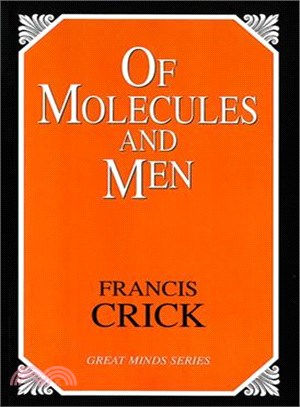
These three 1966 lectures by Noble laureate Crick explain why "vitalism," the idea that an intangible life force beyond the grasp of science distinguishes the animate from the inanimate, is itself dead. In his first lecture he dismisses vitalism as unnecessary; in the second he explains why he believes it to be unnecessary due to his understanding of DNA, RNA and their associated array of enzymes; in the third, he predicts that vitalism, in which everyone believed in the past, and some believe in the present, will in the near future be the exclusive territory of cranks. Annotation c2004 Book News, Inc., Portland, OR (booknews.com)
作者簡介
FRANCIS HARRY COMPTON CRICK was born on June 8, 1916, at Northampton, England. The elder son of Harry and Annie Eliz-abeth Wilkins Crick, he was educated at Northampton Grammar School and Mill Hill School, London. He studied physics at Univer-sity College, London, earning his bachelor's degree in 1937. His pur-suit of a doctorate was interrupted by the outbreak of World War II. Crick worked as a physicist for the British Admiralty during the war, leaving in 1947 to study biology. He earned his doctorate at Caius College, Cambridge University, in 1953.?
Crick was a laboratory scientist at Cavendish Laboratory, Cam-bridge University. In 1962 he became director of Cambridge Univer-sity's Molecular Biology Laboratory. From 1977 he was a faculty member at the Salk Institute for Biological Studies in San Diego, and is now a distinguished professor and president emeritus of the insti-tute's Kieckhefer Center for Theoretical Biology. He was a visiting lecturer at the Rockefeller Institute, New York City, and a visiting pro-fessor at Harvard University. In 1959 he was elected a Fellow of the Royal Society.?
In 1962 Crick won the Nobel Prize in physiology/medicine, with James D. Watson and Maurice H.F. Wilkins, for studies of the mole-cular structure of DNA. Queen Elizabeth II awarded him the Order of Merit in 1992.?
Crick is the author of numerous papers and articles on molecular biology, and four books: Of Molecules and Men (1966), Life Itself: Its Origin and Nature (1981), What Mad Pursuit: A Personal View of Sci-entific Discovery (1988), and The Astonishing Hypothesis: The Scientific Search for the Soul (1994).