商品簡介
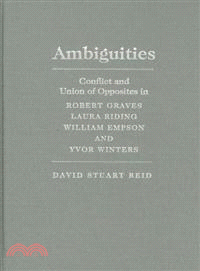
The work is a major scholarly monograph on the discovery of ambiguity as an expressive resource in the criticism, literary theory and poetic practice of Robert Graves, Laura Riding, William Empson and Yvor Winters --- critical 20th c literary figures, poets and critics.As literary history, it examines the development of the critical understanding of ambiguity among the four poet-critics, and in doing so makes a bid for the centrality of the topic in the theory and practice of the second wave of Anglo-American Modernism. As literary theory, it argues for the abiding interest of their contribution, in the face of later Post-Modernist formulations and concerns, which have generally hidden or made something different of it. As literary criticism, it sets out to show how the poetry of all four explores ambiguity intellectually, imaginatively and emotionally with a liveliness and seriousness that deserves the attention, not just of literary historians and theorists, but of anyone interested in poetry. There have been excellent discussions of all four poet /critics, but no one has tried to bring them together so that they cast light on each other's work or on the concerns of Modernism. And no other scholar has so successfully reduced the varieties of ambiguity to a master theme of the interplay of conflict and transcendence of conflict as an intellectual and esthetic adventure of a high order.Dr. Reid begins with a historical account of ambiguity as a literary topic of the early 20th century. Ambiguity may take the form of psychological conflict or paradoxical union of opposites. Empson is the central figure, with I. A Richards in the background; Graves is a pioneer of the analysis of poetry and conflict, but in the analysis of Shakespeare's Sonnet 129 in A Survey of Modernism, he, in collaboration with Riding, turns to the resolution of conflict in paradox; Winters comes in as adversary of ambiguity in his criticism but in his poetry strikingly as one whose power springs from conflict and paradox. Reid defines the matter of ambiguity among these poet-critics in contexts of Romanticism, Symbolism and T. S. Eliot's intervention in these traditions, of Freudian interpretation of dreams and of the linguistic turn. Among all four poet-critics, ambiguity, whether as conflict or as the union of opposites, turns out to be the field of a possible modern heroism. He concludes that the critical achievement of Empson and Winters and their poetical achievement, along with Graves's and Riding's, make ambiguity an important topic in the history of modernism, but not just a matter of history: the weight and substance of their work shows how ambiguity is a continuing source of the power of words, like metaphor, not a weakness. David Stuart Reid is an active research scholar and critic with numerous publications to his credit and has taught in Canada, the United States and ,latterly, in the United Kingdom (University of Stirling). He lives in France.
作者簡介
David Reid holds a Ph.D from University of Brtish Columbia and an MA from St Andrews University,Scotland. He has taught in Canada and the United Kingdom latterly at the University of Stirling. He is the author of a number of research monographs and articles.