商品簡介
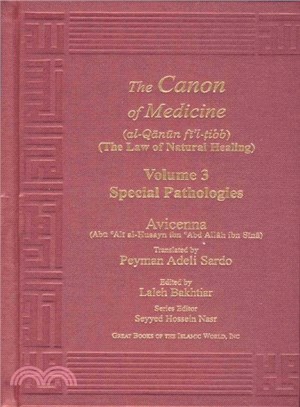
In Volume 3, the various diseases have been discussed systematically, with their etiology, symptoms, diagnosis, prognosis and treatment with simple drugs. Special mention may be made of the following sections: Head: brain, (intemperaments, headache in all its aspects, organic diseases of the brain, epilepsy, paralysis, etc.) eye, ear, nose, mouth, throat, and teeth. Chest: lungs, heart, breasts. Alimentary tract: stomach, intestines, liver, gall bladder and spleen. Intestines and the anus, disorders of the rectum. Urinary tract: the kidneys, bladder and urine. The male reproductive system; the female reproductive system, conception, pregnancy, and diseases of women. Muscles: joints, and feet.
作者簡介
Avicenna's mastery of medicine had already made him a favorite of the ruler. The doors of the palace library were opened to him and he enjoyed a reputable position at court. But the pressure of political turmoil in Central Asia caused by the growing power of Mahmud of Ghazna was making life difficult and unstable in his. home province and eventually forced Avicenna to abandon Bukhara for Jurjaniyah and finally leave that region altogether for Jurjan. In 403/1012, amidst great hardships, in which several of his companions perished, Avicenna crossed the desert to Khurasan. Accord- ing to most traditional authorities, he visited the famous Sufi saint and poet, Abu Said ibn Abi1-Khair, before reaching Jurjan, where he hoped to meet the famous patron of the arts, Qabus ibn Wushmgir. But upon arrival he discovered that his would-be patron had already died.Disappointed by this misfortune, he retired to a village for a few years and then left for Rai sometime between 405/1014 and 406/1015. At this time Persia was under the control of the Buyid dynasty, various members of which ruled over the different provinces of the country. Avicenna spent some time at the court of Fakhr al-Dawlah in Rai and then set out for Hamadiin to meet another member of this dynasty, Shams al- Dawlah. This meeting was made easy, for soon after his arrival in that city he was asked to treat the ruler, who had become ill. Shams al-Dawlah recovered, and Avicenna be- came so great a favorite at court that he was finally made a wazir, a position whose heavy duties he performed for several years until the ruler's death. Then his political fortunes took a bad turn and upon his refusal to continue as wazir he was imprisoned and could only escape by taking advantage of a siege of Hamadan, and then incognito in the dress of a der- vish.Having freed himself at last from his involvements in Hamadan, Avicenna set out for Isfahan, which, as a great center of learning, he had wanted to visit for many years. In Isfahan he came to the attention of 'Ala' al-Dawlah and en- joyed a long period of peace in that city which lasted fifteen years. During that time he wrote many important works and even began to study astronomy and to construct an observa- tory. However, even this peaceful interim in a tumultuous life was interrupted by the invasion of Isfahan by the son of Mahmud of Ghazna, who had forced Avicenna to leave his original abode in his youth, an invasion which caused many of the sage's works to be lost. Deeply disturbed by these conditions and suffering also from an attack of colic, he returned once again to Hamadan where he died in 428/1037 and where his tomb is to be found today.Thus ended a life which saw many political upheavals and was itself marked by many difficulties. Avicenna experienced numerous ups and downs in life, numerous happy days, but some difficult and trying ones as well. He acted most often as a physician to various princes and so led a very active social life. On occasion he even had to accept the responsi- bility of running a state. Yet he lived at the same time an in- tense intellectual life, as witnessed by the number and na- ture of his works and the quality of his students. He was a man of great physical power, spending long nights in gay festivities and going on from there to write a treatise on some question of philosophy or science. He was also a man of re- markable concentrative powers, dictating some of his works to a scribe while riding on horseback with the king to a battle. In fact none of the external disturbances of the world seems to have affected his intellectual output. The man who was so immersed in the life of the world in both politics and at court was also able to lay the foundation of medieval scholas- tic philosophy, to synthesize the Hippocratic and Galenic traditions of medicine, and to influence the Islamic arts and sciences in a way which no other figure has ever been able to do before or after him.