商品簡介
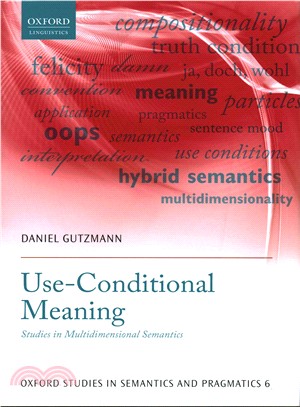
This book seeks to bring together the pragmatic theory of 'meaning as use' with the traditional semantic approach that considers meaning in terms of truth conditions. Daniel Gutzmann adopts core ideas by the philosopher David Kaplan in assuming that the meaning of expressions such as oops or damn can be captured by giving the conditions under which they can be felicitously used. He develops a multidimensional approach to meaning, called hybrid semantics, that incorporates use conditions alongside truth conditions in a unified framework. This new system overcomes the empirical gaps and conceptual problems associated with previous multidimensional systems; it also lessens the burden on the compositional system by shifting restrictions on the combination of use-conditional expressions to the lexicon-semantics interface instead of building them directly into the combinatoric rules. The approach outlined in this book can capture the entire meaning of complex expressions, and also has natural applications in the analysis of sentence mood and modal particles in German, as Gutzmann's two detailed case studies demonstrate. The book will be a valuable resource for linguists working in the fields of semantics, pragmatics, and philosophy of language, as well as to philosophers and cognitive scientists with an interest in meaning in language.
作者簡介
Daniel Gutzmann, Post-doctoral researcher, University of Frankfurt
Daniel Gutzmann is a postdoc at the Institute of Linguistics at University of Frankfurt. His research interests are semantics, pragmatics, and philosophy of language. He has worked and published on the semantics of various kinds of non-truth conditional meaning, including expressives, modal particles, personal datives, sentence mood, and verum focus, as well as on the pragmatics of quotation. He is the co-editor ofBeyond Expressives: Explorations in Use-Conditional Meaning (Brill, 2013) and ofApproaches to Meaning: Composition, Values, and Interpretation (Brill, 2014).