



Gasification process
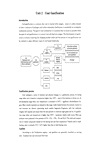
Coal undergoes a series of chemical and physical changes in a gasification process. At drying stage when coal is heated at temperature higher than 100 ℃, most of the moisture is driven out. At devolatilization stage when coal temperature is increased to 500 ℃, significant devolatilization begins. More volatile materials are released at this stage. Liable bonds between the aromatic clusters in coal structure are cleaved, generating much smaller fragments. Fragments with low molecular weights will vaporize and escape from the coal particle to constitute light gases and tar. At gasification stage when coal temperature is higher than 900 ℃, maximum volatile yield occurs. More gas products were produced in the presence of CO, CO2, CH4, H2 and H2O. The yield and composition of volatile compounds depend on the heating rate and final temperature.Volatile yield at rapid-heating rates is normally 20-40% higher than that at slow-heating rates.
Gasifier
According to the fluidization regime, coal gasifiers are generally classified as moving bed, fluidized bed and entrained flow bed.
a) Moving-bed gasifier
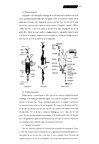
Lurgi gasifier is the oldest gasifier technology that is still widely used in industries. Coal is fed into an atmospheric-pressure-bunker above the gasifier. A valve on the bottom of bunker will be opened when the bunker is full, dropping the coal into a coal lock. Then, the valve will be closed and coal lock is pressured until it reaches the reaction pressure of the gasifier, typically 2.4 to 3.5 MPa. After that, a valve at the bottom of coal lock will be open, dropping the coal into the gasifier. BGL (British Gas Lurgi) gasifier is a slagging version of a Lurgi gasifier. Instead of a grate at the bottom of the gasifier, oxygen and steam are injected into the slag layer through tuyeres. A stirrer near the top of the bed allows the use of caking coals.
Lurgi gasifier BGL gasifier Winkler gasifier
b) Fluidized-bed gasifier
Winkler gasifier, commercialized in 1926, was the first industrial fluidized-bed gasifier technology. In the bubbling fluidized bed regime, coal is fed into the gasifier at atmospheric pressure. At the same time, The gas consisting of steam and air (or oxygen) is splitted into two separated streams which are fed into the gasifier. The stream from the bottom will fluidize the solid coal particles and react with the solid coal combined with another stream from the side. About 70% of the ash is carried by fluidizing gas and is taken into the head space. The low operating temperature and pressure of the winkler gasifier limits the throughput of the gasification. Lignite and sub-bituminous coal with high ash fusibility temperatures are considered as ideal feedstocks under low operating temperatures .
c) Entrained flow gasifiers
The first commercial application of entrained flow coal gasifier was developed by Texaco in 1983. The standard method of feeding coal into a high pressure entrained flow gasifier is to finely grind the coal and then mix it with water to form a pumpable slurry. The slurry and oxygen are injected into the top of the gasifier, and the gas/solid/slag mixtures flow downward. The coal/water slurry feed technique works well with bituminous coals. When using lower grade coals, the water/coal ratio of the slurry feed is often far in excess of optimum due to the high intrinsic moisture in lower grade coals. Therefore, high water content of the slurry feed had to be vaporized by coal pyrolysis.
d) Unconventional gasifiers
NRG plasma gasifier can be served as an alternative coal gasifier. It utilizes a plasma torch to gasify a solid feedstock. This kind of gasifier is especially attractive for more difficult gasified feedstocks, such as municipal solid waste (MSW). Currently, the largest installed NRG gasifier is the Eco-valley waste-to energy facility in Japan, which gasifies 180 t/d of MSW and automotive shredder waste.
Underground coal gasification
In an underground coal gasification (UCG) process, untapped coal-seams are reacted with insufficient oxygen to create syngas underground. An oxidant, usually air, flows through an injection well into a cavity in a coal seam. The oxygen and water within the coal seam react with the coal to produce syngas, which is withdrawn through a production well. Compared to the above-ground gasifiers, UCG offers a considerable capital cost savings by canceling the gasifier and a considerable operating cost savings by eliminating the cost of mining coal. In UCG process, steam may be generated because some coal seams are aquifers. These steams are benefit for char gasification. Some of them are consumed in the water-gas-shift reaction to produce H2 and CO2 from H2O and CO. In addition, partial of H2 will react with carbon to produce CH4,which can enhance the calorific value of the gas.
Entrained flow gasifiers
Specialized English Words
Devolatilization
Liquefaction.
Slagging To obtain a mixture of shale, clay, coal dust, and other mineral waste produced during coal mining.
Tuyere A water-cooled nozzle through which air is blown into a cupola, blast furnace, or forge.
Pyrolysis Decomposition or transformation of a compound caused by heat.
Seam A line of junction formed by sewing together two pieces of material along their margins.
Expressions and Technical Terms
Moving bed Granulated solids in a process vessel that are circulated either by mechanically or by gravity flow; used in catalytic and absorption processes.
Fluidized bed A cushion of air or hot gas blown through the porous bottom slab of a container which can be used to float a powdered material as a means of drying, heating, quenching, or calcining the immersed components.
Entrained flow bed In the entrained flow gasifier a dry pulverized solid, an atomized liquid fuel or a fuel slurry is gasified with oxygen (much less frequent: air) in co-current flow. The gasification reactions take place in a dense cloud of very fine particles.
BGL
(British Gas Lurgi ) The principle of a slagging fixed-bed gasifier basing upon the British Gas/Lurgi (BGL) technology is predominantly applied for the generation of high-quality syngas which is free of any attendant substances and can be processed to various product.
Winkler gasifier High-temperature winkler gasifier is one of the oldest gasification technologies which was developed by Rheinbraun in Germany in 1926.
Caking coals When many bituminous coals are heated, they soften and form a plastic mass that swells and resolidifies into a porous solid. Coals that exhibit such behavior are called caking coals.
Notes
① Coal gasification: Coal gasification is the process of producing syngas–a mixture consisting primarily of methane (CH4) carbon monoxide (CO), hydrogen (H2), carbon dioxide (CO2) and water vapor (H2O)–from coal and water, air and/or oxygen.
② Coal gasifier: Several types of gasifiers are currently available for commercial use: counter-current fixed bed, co-current fixed bed, fluidized bed, entrained flow, plasma, and free radical gasifier.
③ Underground coal gasification (UCG): UCG takes advantage of the same chemical reactions of coal to produce product gases, as those occurring in conventional gasifier reactors. The main difference is that in UCG the underground coal seam itself becomes the reactor, so that the gasification of the coal takes place underground instead of in a manufactured gasification vessel at the surface.
Reading Material 2: Upgrading T
收起全部↑
大陸出版品因裝訂品質及貨運條件與台灣出版品落差甚大,除封面破損、內頁脫落等較嚴重的狀態,其餘商品將正常出貨。
特別提醒:部分書籍附贈之內容(如音頻mp3或影片dvd等)已無實體光碟提供,需以QR CODE 連結至當地網站註冊“並通過驗證程序”,方可下載使用。
無現貨庫存之簡體書,將向海外調貨:
海外有庫存之書籍,等候約45個工作天;
海外無庫存之書籍,平均作業時間約60個工作天,然不保證確定可調到貨,尚請見諒。
為了保護您的權益,「三民網路書店」提供會員七日商品鑑賞期(收到商品為起始日)。
若要辦理退貨,請在商品鑑賞期內寄回,且商品必須是全新狀態與完整包裝(商品、附件、發票、隨貨贈品等)否則恕不接受退貨。