商品簡介
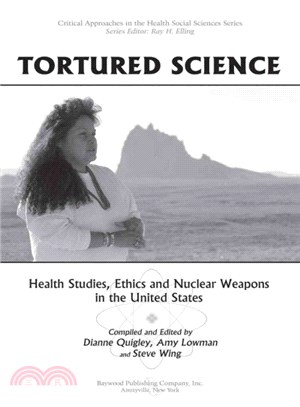
ABOUT THE BOOK The U.S.A.'s nuclear weapons program has exposed workers and the public to health hazards since World War II. In the 1980s and 1990s, federal health agencies responded to new revelations about these hazards by pouring millions of dollars into research on the health impacts of radiation. In Tortured Science: Health Studies, Ethics and Nuclear Weapons in the United States, community health activists and researchers reflect on the research program for addressing the health effects of nuclear weapons production at Hanford, WA, Rocky Flats, CO, Livermore Labs, CA, and Fernald, OH. The authors describe conflicts of interest, data suppression, technical inadequacies, and other examples of how researchers failed in their social responsibility to the affected human populations. The research program's health studies did not lead to any meaningful follow-up on the major health concerns of community members, nor have they helped communities seek reparations for high radiation exposures that may have contributed to thyroid, bone, lung and other diseases. In Tortured Science, several ethicists review these health research problems. Research ethics as a discipline seeks to protect individuals and groups, obtain approval from affected communities, mitigate potential research harms, and guard against vigilance, scientific contrivance, denial, and suppression of findings. Such protections were not adequately provided in the research program on the health effects of nuclear weapons production, as critiqued in the ethical reviews. This book compels us to develop a new ethical framework for scientific research on military-industrial and other sources of contamination.Intended Audience: Public health professionals; graduates/undergraduates in public health, community health, environmental studies, epidemiology, medical anthropology, public sociology, ethics/religious studies, and science policy; government health researchers at federal health agencies, centers for ethics and bioethics (private/academic), and community health organizations; community-based researchers and environmental organizations; nuclear weapons and peace organizations.
作者簡介
ABOUT THE EDITORS Dianne Quigley, Ph.D., is an adjunct assistant professor of research at Brown University's Center for Environmental Studies and lecturer at UMass-Dartmouth. She received a 2010 National Science Foundation grant for Ethics Education in Science and Engineering and is an ethics consultant on several other federal grants. She was previously the principal investigator of National Institutes of Health grants "The Collaborative Initiative for Research Ethics in Environmental Health" (2000–2007) and "Nuclear Risk Management to Native Communities" (1994–2000). Dr. Quigley was executive director of the Childhood Cancer Research Institute (1987–2000). She earned her Ph.D. in religious studies from Syracuse University in 2009.Amy Lowman, M.P.H., is a project manager and research associate at the University of North Carolina, School of Public Health. She has several years of experience working with community-based organizations on environmental health and environmental injustice.Steve Wing received his Ph.D. in epidemiology from the University of North Carolina–Chapel Hill, where he has been on the faculty since 1985. His teaching and research focus on occupational and environmental health. He has conducted studies of radiation-exposed workers at U.S. Department of Energy nuclear weapons facilities in Oak Ridge, Hanford, Los Alamos, and Savannah River, and has worked with several community-based organizations near nuclear weapons sites. Dr. Wing has conducted several studies of environmental injustice and environmental health research ethics, and he is a founding member of the North Carolina Environmental Justice Network.