商品簡介
How poetry and revolution meshed in Red China
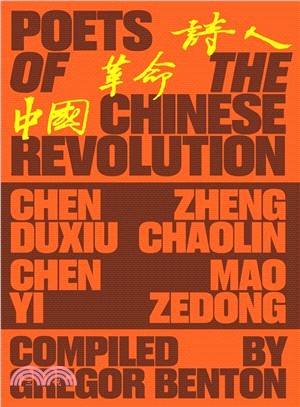
This is a book of poems by four veteran Chinese revolutionaries. Chen Duxiu led China's early cultural awakening before founding the Communist Party in 1921. Mao led the Party to power in 1949. Zheng Chaolin, Chen Duxiu's disciple and, like him, a convert to Trotskyism, spent 34 years in jail, first under the Nationalists and then under Mao. The guerrilla Chen Yi wrote poems in mountain bivouacs or the heat of battle. All wrote in the classical style, which Mao Zedong officially proscribed, though he and other leaders kept using it. Poetry, especially classical poetry, plays a different role in China, and in Chinese revolution, from in the West - it is collective and collaborative. The four poets were entangled with one another in various ways. Chen Duxiu inspired Mao, though Mao later denounced him. Mao and Zheng joined the leadership under Chen Duxiu in the 1920s, though Mao later gaoled Zheng. The maverick Chen Yi was Zheng's associate in France and Mao's comrade-in-arms in China, but he clashed with the Maoists in the Cultural Revolution. Together, the four poets illustrate the complex relationship between Communist revolution and Chinese cultural tradition.
作者簡介
Gregor Benton is Professor Emeritus of Chinese History at Cardiff. He has published twelve prior books on Marxism, political humor, the history of the Chinese Communist Party, Red guerillas in the 1930s, the Sino-Japanese War, dissent in China, Chinese Trotskyism, Hong Kong, the theory of moral economy, and overseas Chinese. His book Mountain Fires: The Red Army's Three-Year War in South China, 1934-1938 (1992) won several awards, including the Association of Asian Studies' prize for the best book on modern China.
Feng Chongyi works on modern China at Sydney's University of Technology and is Professor of History at Nankai University.