商品簡介
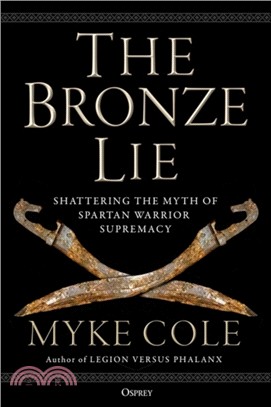
The Spartan hoplite enjoys unquestioned currency as history's greatest fighting man. Raised from the age of seven in the agoge, a military academy legendary for its harshness, Spartan men were brought up to value loyalty to the polis (the city-state) above all else, and to prize obedience to orders higher than their own lives. The last stand at Thermopylae made the Spartans legends in their own time, famous for their brevity, ability to endure hardship, control their emotions, and to never surrender - even in the face of impossible odds, even when it meant their certain deaths.
But was this reputation earned? Or was it simply the success of a propaganda machine that began turning at Thermopylae in 480 BC? Even a cursory examination of the sources shows Spartan armies losing battles frequently and completely. Spartans display cowardice, intense emotionality, bad judgment, and that worst of all military liabilities, indecision in a crisis. They could and did surrender, most famously at Sphacteria in 425 BC, complaining that the Athenians who wisely stood off and showered them with arrows only won because they refused to use “masculine weapons.”
Examining the historical record, both literary and material, paints a very different picture of Spartan arms – a society dedicated to militarism not in service to Greek unity or to the Spartan state itself, but as a desperate measure intended to keep its massive population of helots (a near-slave underclass) in line, forcing them to perform the mundane work of farming, cleaning, building and crafting to permit the dandified Spartan citizens (spartiatai) the time they needed to focus on their military training.
Sparta did rightfully earn praise as the mightiest hoplite force in Greece during the Peloponnesian Wars, forcing their Athenian rivals to take shelter behind their long walls rather than meet them in matched combat. But success in the Peloponnesian Wars gave Sparta only a brief period of hegemony over Greece. The Spartan system of oppression that worked only intermittently over the helots utterly failed when applied to other Greeks. The Spartans were unable to hold onto hegemony and were soon defeated, marginalized, and finally resigned to the dustbin of history. Today, there is no greater testament to this than the relative position of modern Sparta and its famous rival Athens. Modern Sparta is little more than a wide-space in the road, of most interest to tourists. Athens meanwhile, is the vibrant capital of Greece.
Covering Sparta's full classical history from the polis' (city-state) foundation to its final subsumption by Rome in the first century BC, this book will examine the myth of Spartan warrior supremacy, and compare it to the historical record. It will dig into the minutiae of Spartan warfare – arms and armor, tactics and strategy, the personalities of commanders and the common soldiery alike. It will look at the major battles, with a special focus on previously under-publicized Spartan reverses that have been left largely unexamined. It will also re-examine major Spartan “victories” that, under careful examination of the facts, should probably be reclassified as defeats. Most importantly, It will re-examine Thermopylae itself, a propaganda victory utterly out of proportion to its actual impact – a defeat that wasn't even accomplished by 300 Spartans, but rather by thousands of allied Greeks, all for the net effect of barely slowing a Persian advance that went on to roam Greece unchecked and destroy Athens itself.