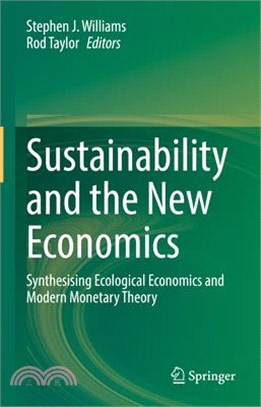
This multidisciplinary book provides new hope for sustainability given recent developments in economics - but only if swift and strong action consistent with Earth's biophysical limits is taken in major economies. It argues that currency-issuing governments, in particular, have much more capacity for corrective action than mainstream thinking allows.
The book begins by outlining humanity's current predicament of gross overshoot and laments the half-century of missed opportunities since The Limits to Growth (1972). What was once economic growth is now uneconomic growth in high-income nations and is not advancing wellbeing. Meanwhile, low-income nations need help to escape poverty via growth while protecting their environments and the global commons.
The book acknowledges the fundamental importance of ecological economics in any discussion of sustainability and summarises its main principles. But new developments in macroeconomics are turning political economy on its head, giving policymakers greater control over outcomes once they discard the straitjacket of mainstream thinking and subservience to financial markets. Gone are the days of 'there is no alternative' where people serve the economy rather than the economy serving us. The result is expanded policy options with profound implications for sustainability and general wellbeing in the context of the existential crisis we face. What is now needed is a synthesis between our increasing knowledge of resource throughput and waste sink limits (on the one hand) and the power of governments to urgently harness, transform and distribute resources for the common good (on the other). Central to this synthesis is a correct understanding of government financial constraints versus real resource constraints.
The book explores essential questions for sustainability:
- To what extent was The Limits to Growth (1972) correct in warning of resource limits and potential collapse?
- Do the UN Sustainable Development Goals, notions of a Green New Deal, Just Transition or Build Back Better provide pathways to sustainability?- Can global economic growth continue, at least to some extent, by 'decoupling' that growth from environmental harm (fast enough and deeply enough)? If not, what are the alternatives?
- Could the abandonment of economic growth in high-income nations paradoxically result in an increase in wellbeing?
- Is full employment possible or must some people's rights and dignity be sacrificed to control inflation?
- What features would a sustainable renewable energy system have given resource limits?
- What is the relationship between human population numbers and sustainability?
- What are legitimate targets for governments if increased wellbeing is the primary goal? Are there alternatives to GDP as a measure of prosperity?
- Are there legal options for citizens who feel their governments are negligent in the face of environmental crises such as the climate emergency?The book joins the growing chorus of authoritative voices calling for a complete overhaul of the dominant economic system - a system that was never fit for purpose and now represents a danger to humanity. We conclude with policy recommendations based on the new economics that, if urgently implemented, would come close to guaranteeing a sustainable future.
外文書商品之書封,為出版社提供之樣本。實際出貨商品,以出版社所提供之現有版本為主。部份書籍,因出版社供應狀況特殊,匯率將依實際狀況做調整。
無庫存之商品,在您完成訂單程序之後,將以空運的方式為你下單調貨。為了縮短等待的時間,建議您將外文書與其他商品分開下單,以獲得最快的取貨速度,平均調貨時間為1~2個月。
為了保護您的權益,「三民網路書店」提供會員七日商品鑑賞期(收到商品為起始日)。
若要辦理退貨,請在商品鑑賞期內寄回,且商品必須是全新狀態與完整包裝(商品、附件、發票、隨貨贈品等)否則恕不接受退貨。