


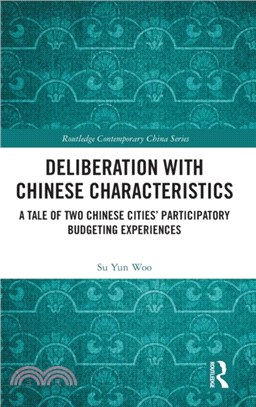
Woo investigates examples of the Chinese government using methods normally associated with deliberative democracy to involve their citizenry in decision-making at a sub-national level.
Despite the tightening of civil society under Xi there are still some opportunities for the Chinese people to articulate their opinions and participate in decision-making. The proliferation of deliberative democratic practices is motivated by the Communist Party of China''s (CCP) strong governance logic, to strengthen regime legitimacy and stability. Woo examines deliberative participation through the lens of participatory budgeting in China, and investigates its impact on local governance. To make sense of this model of deliberative democratic governance in China, she unpacks the relationship between deliberative democracy and governance. This requires delving into the forms and functions of deliberation with Chinese characteristics, especially to show how they depart from the Western deliberative democratic experiences. What is the Chinese deliberative discourse in relation to the Western conception of deliberative democracy? How can the Chinese deliberative experience contribute to the concept of deliberative governance? How does deliberation impact upon local governance in China?
An intriguing read both for scholars of Chinese politics and for political scientists looking at comparative examples of deliberative governance.
外文書商品之書封,為出版社提供之樣本。實際出貨商品,以出版社所提供之現有版本為主。部份書籍,因出版社供應狀況特殊,匯率將依實際狀況做調整。
無庫存之商品,在您完成訂單程序之後,將以空運的方式為你下單調貨。為了縮短等待的時間,建議您將外文書與其他商品分開下單,以獲得最快的取貨速度,平均調貨時間為1~2個月。
為了保護您的權益,「三民網路書店」提供會員七日商品鑑賞期(收到商品為起始日)。
若要辦理退貨,請在商品鑑賞期內寄回,且商品必須是全新狀態與完整包裝(商品、附件、發票、隨貨贈品等)否則恕不接受退貨。











