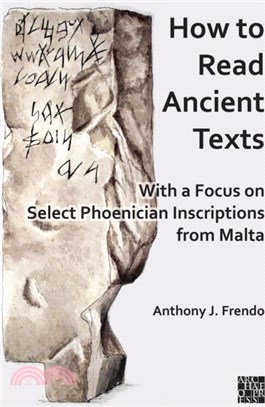
How to Read Ancient Texts foregrounds the principles of interpretation that scholars employ when reading ancient inscriptions. In order to better come to grips with Canaanite, such as Phoenician, inscriptions, we need to first understand how people wrote and read texts in the ancient Mediterranean world, including that of the Greeks and Romans. The use of continual script and lack of punctuation did not pose insurmountable problems to the ancients, since spoken language is not built on a division between words but on two-second spurts of sounds with pauses in between. This shows the crucial role that lectors and consequently orality played in antiquity. It is clear that philological analysis is crucial when it comes to reading Phoenician inscriptions, such as those examined here. However, in texts with no word division, no punctuation, and no vowels (such as Phoenician inscriptions), context plays a crucial role. That context turns out to be threefold: the textual context that an inscription itself provides, its archaeological context, and also (as in the case of the papyrus inscription examined as a case study here) the wider Mediterranean context, such as that of ancient Egypt. In the case of the Phoenician inscription CIS I, 123 it is the archaeological context that allows us to pin down one highly probable interpretation out of multiple philological solutions that are theoretically possible. The Phoenician inscriptions examined here show us more clearly and with greater probability that the Phoenicians in Malta did practice child sacrifice and that they also had very strong links with the Phoenicians in Egypt.
外文書商品之書封,為出版社提供之樣本。實際出貨商品,以出版社所提供之現有版本為主。部份書籍,因出版社供應狀況特殊,匯率將依實際狀況做調整。
無庫存之商品,在您完成訂單程序之後,將以空運的方式為你下單調貨。為了縮短等待的時間,建議您將外文書與其他商品分開下單,以獲得最快的取貨速度,平均調貨時間為1~2個月。
為了保護您的權益,「三民網路書店」提供會員七日商品鑑賞期(收到商品為起始日)。
若要辦理退貨,請在商品鑑賞期內寄回,且商品必須是全新狀態與完整包裝(商品、附件、發票、隨貨贈品等)否則恕不接受退貨。