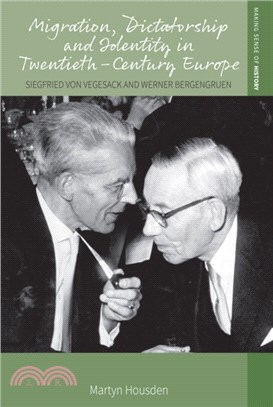
The cultural borders of Europe are today more visible than ever, and with them comes a sense of uncertainty with respect to liberal democratic traditions: whether treated as abstractions or concrete r
Talking about the Holocaust has provided an international language for ethics, victimization, political claims, and constructions of collective identity. As part of a worldwide vocabulary, that langua
From consumer products to architecture to advertising to digital technology, design is an undeniably global phenomenon. Yet despite their professed transnational perspective, historical studies of des
At a time when rapidly evolving technologies, political turmoil, and the tensions inherent in multiculturalism and globalization are reshaping historical consciousness, what is the proper role for his
Employing an innovative methodological toolkit, Doing Conceptual History in Africa provides a refreshingly broad and interdisciplinary approach to African historical studies. The studies assembled her
Is there a "Nordic history"? If so, what are its origins, its scope, and its defining features? In this informative volume, scholars from all five Nordic nations tackle a notoriously problematic histo
Few would dispute that many Western industrial democracies undertook extensive deregulation in the 1970s and 1980s. Yet this narrative, in its most familiar form, depends upon several historiographica
During his political career, Helmut Kohl used his own life story to promote a normalization of German nationalism and to overcome the stigma of the Nazi period. In the context of the cold war and the
The cultural borders of Europe are today more visible than ever, and with them comes a sense of uncertainty with respect to liberal democratic traditions: whether treated as abstractions or concrete r
Since its invention by Renaissance humanists, the myth of the "Middle Ages" has held a uniquely important place in the Western historical imagination. Whether envisioned as an era of lost simplicity o
As one of the premier historical thinkers of his generation, Jörn Rüsen has made enormous contributions to the methods and theoretical framework of history as it is practiced today. In Evidence and Me
Heritage, as an area of research and learning, often deals with difficult historical questions, due to the strong emotions and political commitments that are often at stake. In this, it poses particul
For many years, histories of the Holocaust focused on its perpetrators, and only recently have more scholars begun to consider in detail the experiences of victims and survivors, as well as the docume
For millennia, messianic visions of redemption have inspired men and women to turn against unjust and oppressive orders. Yet these very same traditions are regularly decried as antecedents to the viol
A scholar of Hellenistic and Prussian history, Droysen developed a historical theory that at the time was unprecedented in range and depth, and which remains to the present day a valuable key for unde
"Viktor Frankl was a psychiatrist and philosopher who survived the Holocaust and went on to found the third school of Viennese psychotherapy. This book is an intellectual biography of Frankl, describi
The Weimar era in Germany is often characterized as a time of significant change. Such periods of rupture transform the way people envision the past, present, and future. This book traces the concepti
From consumer products to architecture to advertising to digital technology, design is an undeniably global phenomenon. Yet despite their professed transnational perspective, historical studies of des
Talking about the Holocaust has provided an international language for ethics, victimization, political claims, and constructions of collective identity. As part of a worldwide vocabulary, that langua
"During his political career, Helmut Kohl used his own life story to promote a normalization of German nationalism and to overcome the stigma of the Nazi period. In the context of the Cold War and the
In the last two decades our empirical knowledge of the Holocaust has been vastly expanded. Yet this empirical blossoming has not been accompanied by much theoretical reflection on the historiography.
This anthology in the Making Sense of History series is designed for academic readers and general readers with a special interest in Jewish narratives of the Holocaust. It seeks to fill a historical g
Bohemia and Moravia, today part of the Czech Republic, was the first territory with a majority of non-German speakers occupied by Hitler’s Third Reich on the eve of the World War II. Tens of thousands
German historian Droysen (1808-1884) articulated the idea that the study of history trains the mind for "historical thinking," which can lead to activism. This study examines the context of Droysen's
A vast amount of literature-both scholarly and popular-now exists on the subject of historical memory, but there is remarkably little available that is written from an African perspective. This volume