This book explores the most significant computational methods and the history of their development. It begins with the earliest mathematical / numerical achievements made by the Babylonians and the Gr
This book presents computer programming as a key method for solving mathematical problems. There are two versions of the book, one for MATLAB and one for Python. The book was inspired by the Springer
This is the first of three volumes providing a comprehensive presentation of the fundamentals of scientific computing. This volume discusses basic principles of computation, and fundamental numerical
This is the third of three volumes providing a comprehensive presentation of the fundamentals of scientific computing. This volume discusses topics that depend more on calculus than linear algebra, in
This is the second of three volumes providing a comprehensive presentation of the fundamentals of scientific computing. This volume discusses more advanced topics than volume one, and is largely not a
This book is open access under a CC BY 4.0 license.This easy-to-read book introduces the basics of solving partial differential equations by means of finite difference methods. Unlike many of the trad
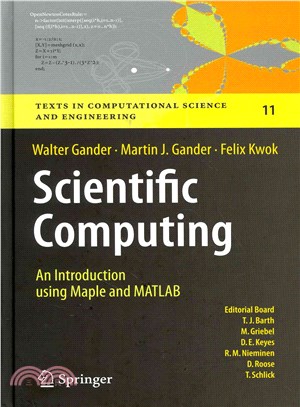
This textbook is an introduction to Scientific Computing, in which several numerical methods for the computer-based solution of certain classes of mathematical problems are illustrated. The authors sh
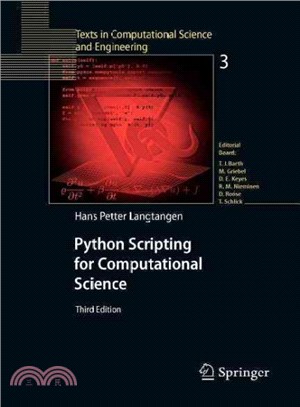
The book serves as a first introduction to computer programming of scientific applications, using the high-level Python language. The exposition is example and problem-oriented, where the applications
This book presents computer programming as a key method for solving mathematical problems. There are two versions of the book, one for MATLAB and one for Python. The book was inspired by the Springer
This book presents computer programming as a key method for solving mathematical problems. There are two versions of the book, one for MATLAB and one for Python. The book was inspired by the Springer
This textbook provides an introduction to numerical computing, and includes anextensive examination of the challenges that arise when trying to derive andimplement methods that a computer can resolve
This book is intended for students of computational systems biology with only a limited background in mathematics. Typical books on systems biology merely mention algorithmic approaches, but without o
This book gives an introduction to the finite element method as a general computational method for solving partial differential equations approximately. Our approach is mathematical in nature with a s
Scientific computing is the study of how to use computers effectively to solve problems that arise from the mathematical modeling of phenomena in science and engineering. It is based on mathematics, n
Now in its fourth edition, this volume collates an array of material on using MATLAB and Octave in science computing, offering hundreds of examples, solved exercises, and programs that will greatly ex
This book gives an introduction to the finite element method as a general computational method for solving partial differential equations approximately. Our approach is mathematical in nature with a s
-The present book provides an introduction to using space-filling curves (SFC) as tools in scientific computing. Special focus is laid on the representation of SFC and on resulting algorithms. For exa
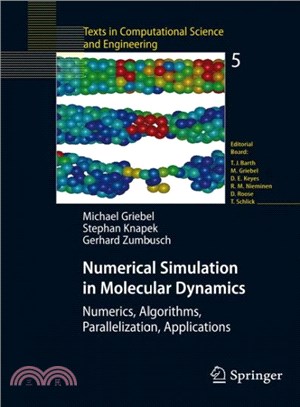
This book details the necessary numerical methods, the theoretical background and foundations and the techniques involved in creating computer particle models, including linked-cell method, SPME-metho
The goal of this book is to demonstrate how to develop tailored, flexible working environments built from small programs (scripts) written in the easy-to-learn, high-level language Python. The focus i
This book details the necessary numerical methods, the theoretical background and foundations and the techniques involved in creating computer particle models, including linked-cell method, SPME-metho