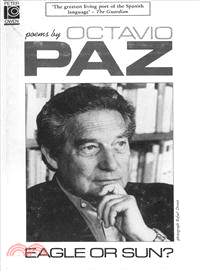
This book is in part an exploration of Paz's native Mexico and also a study of relations between language and the poet, reality and language, and the poet and history.
In its front-page review of Alternating Current, The New York Times Book Review called Octavio Paz “an intellectual literary one-man band” for his ability to write incisively and with dazzling origina
In Conjunctions and Disjunctions, Octavio Paz offers what he calls his ?rough draft” for a history of man, which is a history of human nature rather than of men or of cultures and civilizations. For P
Octavio Paz claims in this essential work that the two painters who had the greatest influence on the twentieth century were Pablo Picasso and Marcel Duchamp. If that conjunction surprises at first, P
*注意:此書為POD (Print on Demond)少量印製Octavio Paz was born in Mexico City in 1914 to a family of Spanish and native Mexican descent. He was the author of more than twenty-five books of poetry and prose. In
The speech delivered by Paz in acceptance of the 1990 Nobel Prize for Literature, in which he discusses gratitude, separateness, and modernity. Published in a handsome bilingual edition. Translated by
Written with a poet's sensibility and a diplomat's sense of history, these essays view a contemporary world poised between the upheaval of the 1960s and the uncertainties of the 1980s. "Essay
Configurations was his first major collection to be published in this country, and includes in their entirety Sun Stone (1957) and Blanco (1967). Paz himself translated many of the poems from the Span