【Articles】‧Jonathan P. Evans:‘African’ Tone in the Sinosphere‧Lillian M. Huang and Tali’ Hayung:Syntax and Semantics of p- in Squliq Atayal‧Paul Jen-kuei Li:The Great Diversity of Formosan Languages‧C
【Articles】‧Tao Gong and William S-Y. Wang:Computational Modeling on Language Emergence: A Coevolution Model of Lexicon, Syntax and Social Structure‧郭必之 (Bit-chee Kwok):語言接觸與規律改變 ──論中古全濁聲母在粵北土話中的表現 (La
【Articles】‧張麗麗 (Li-li Chang):動詞複合與象似性 (Verb Compounding and Iconicity)‧Shu-Fen Chen (陳淑芬):Vowel Length in Middle Chinese Based on Buddhist Sanskrit Transliterations (依據梵文佛教術語的音譯論中古漢語母音的長短問題)‧Zev Hande
【Articles】‧羅鳳珠、曹偉政:唐宋詞單字領字研究‧洪嘉馡、黃居仁:語料庫為本的兩岸對應詞彙發掘‧Mei-chun Liu and Ting-yi Chiang:The Construction of Mandarin VerbNet: A Frame-based Study of Statement Verbs‧古川千春:漢語介詞「離」與日語格助詞「?? (kara)」、「?? (made
【Articles】‧Kawai Chui:Complementary Gestures and Information Types‧Chun-chieh Natalie Hsu:Revisit Relative Clause Islands in Chinese‧Su-miao Huang and Shelley Ching-yu Hsieh:Grammaticalization of Dire
‧William S-Y. Wang:Whither Linguistics?-an editorial‧Chu-Ren Huang&Winfried Lenders:Computational Linguistics and Beyond:An Introduction ‧Charles J. Fillmore, Josef Ruppenhofer&Collin F. Baker
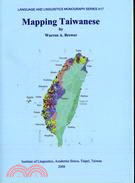
Since submitting my manuscript to the journal three years ago, I have polished off two conference papers and now append them to the monograph as “Mapping Taiwanese goose” and “Mapping Taiwanese bat”.
【Articles】‧K. Alexander Adelaar:The Coming and Going of ‘Lexical Prefixes’ in Siraya‧Paul Jen-kuei Li:Origins of the East Formosans: Basay, Kavalan, Amis, and Siraya‧Chih-Chen Jane Tang:Two Types of C
【Articles】‧Keith Dede:Language Attitudes in Xining, Qinghai‧蔣紹愚 (Shaoyu Jiang):從“盡V——V盡”和“誤V/錯V——V錯”看述補結構的形成 (Development of 盡V——V盡 and 誤V/錯V——V錯: Time of Appearance of the VC Construction)‧郭必之 (Bit-c
【Articles】‧Ian Maddieson:Timing and Alignment: A Case Study of Lai‧Yi Xu:Understanding Tone from the Perspective of Production and Perception‧Matthew Y Chen:Changting Hakka Tone Sandhi: Analytical Cha
【Articles】‧Wayne H. Smith:Taiwan Sign Language Research: An Historical Overview‧Jean Ann:A Functional Explanation of Taiwan Sign Language Handshape Frequency‧Jung-hsing Chang, Shiou-fen Su, and James
【Articles】‧Jerold A. Edmondson, John H. Esling, Jimmy G. Harris, and Tung-chiou Huang:A Laryngoscopic Study of Glottal and Epiglottal/Pharyngeal Stop and Continuant Articulations in Amis──an Austrones
【Articles】‧Gilles Fauconnier:Compression and Emergent Structure‧James H-Y. Tai:Conceptual Structure and Conceptualization in Chinese‧Huei-ju Huang and Michael Tanangkingsing:Repair in Verb-initial Lan
一、詞匯與詞法現象-台灣話的代名詞 二、On Lexical Structure and Syntactic Projection 三、More on Mandarin Chinese Parts of Speech 四、Metaphorical Extension: The Phenomenon of lai 來/khi去' come/go' in Taiwanese 五、Phonol
The Xiāng dialects comprise one of the major families of modern Sinitic languages. However, a number of modern linguists doubt that, as currently constituted, this group forms a valid taxonomic unit.
In Chinese, as in many languages with long written histories, textual sources tend to reflect koines or reginal lingua francas rather than dialects as such. The recording of ordinary regional vernacul
The earlier literary monuments, written in the Mongolian language, serve the most valuable materials in researching the age-old history and culture of the Mongols. The first and most complete co
A dynamic computational model linking up human cognitive-develop?mental properties (local mechanisms) and the transition patterns of sound changes (global phenomena) was built, in order to
目錄 張琨/漢語方言的分類 丁邦新/漢語方言使和方言區域史的研究 W. L. Ballard/Oujiang Wu Tone Sandi: Visi-Pitch Results Hilary Chappell/Towards A Typology of Aspect in Sinitic Languages Chung-yu Chen/From Middle Chinese to M