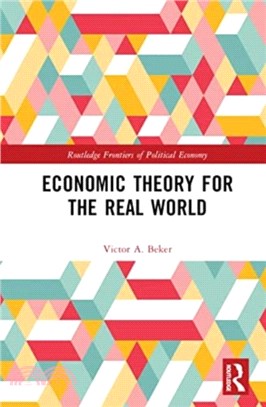
After the Great Financial Crisis, economic theory was fiercely criticized from both outside and inside the discipline for being incapable of explaining a crisis of such magnitude. Slowly but persistently, new strands of economic thought are developing, to replace the old-fashioned neoclassical economic theory, which have a common characteristic: they are better suited to help understand the real-world economy. This book explores the key tenets and applications of these. This book opens with an explanation of the “real world” approach to economics in which theoretical models resemble real-world situations, realistic assumptions are made, and factors such as uncertainty, coordination problems, and bounded rationality are incorporated. Additionally, this book explores the ramifications of considering the economy as both a dynamic system - with a past, present, and future - and a complex one. These theoretical precepts of the real-world economy are then applied to some of the most pressing