商品簡介
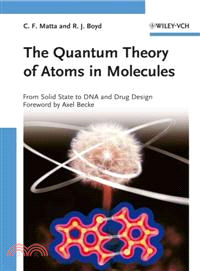
This book distills the knowledge gained from research into atoms in molecules over the last 10 years into a unique, handy reference. Throughout, the authors address a wide audience, such that this volume may equally be used as a textbook without compromising its research-oriented character. Clearly structured, the text begins with advances in theory before moving on to theoretical studies of chemical bonding and reactivity. There follow separate sections on solid state and surfaces as well as experimental electron densities, before finishing with applications in biological sciences and drug-design. The result is a must-have for physicochemists, chemists, physicists, spectroscopists and materials scientists.
作者簡介
Cherif F. Matta is an assistant professor of chemistry at Mount Saint Vincent University and an adjunct professor of chemistry at Dalhousie University, both in Halifax, Canada. He obtained his BSc from Alexandria University, Egypt, in 1987 and gained his PhD in theoretical chemistry from McMaster University, Hamilton, Canada in 2002. He was then a postdoctoral fellow at the University of Toronto, Canada, before being awarded an I. W. Killam Fellowship at Dalhousie University. Professor Matta has held the J. C. Polanyi Prize in Chemistry, two BioVision Next Fellowships, and a Chemistry Teaching Award, and has more than 40 papers and book chapters and two software programs to his credit. His research is in theoretical and computational chemistry with a focus on QTAIM and its applications.
Russell Boyd graduated from the University of British Columbia in chemistry in 1967, receiving his PhD in theoretical chemistry from McGill University in 1971. He subsequently went to Oxford University, UK, as a postdoctoral fellow, before returning to British Columbia with a Killam Postdoctoral Fellowship at the Department of Chemistry from 1973 to 1975. He then joined Dalhousie University, Halifax, where he held the Chair of Chemistry from 1992 to 2005 and became McLeod Chair in 2001. Professor Boyd has published about 200 papers in computational and theoretical chemistry. His current interests include the effects of radiation on DNA and proteins, the mechanism by which a leading anti-tumor drug cleaves DNA, and the design of catalysts.
名人推薦
"…a handsome text that serves to create a one-stop reference point exploring the quantum theory of atoms and molecules in complete detail." (Electric Review, May 2007)
目次
Foreword.
Preface.
List of Abbreviations Appearing in this Volume.
List of Contributors.
1 An Introduction to the Quantum Theory of Atoms in Molecules (Chérif F. Matta and Russell J. Boyd).
1.1 Introduction.
1.2 The Topology of the Electron Density.
1.3 The Topology of the Electron Density Dictates the Form of Atoms in Molecules.
1.4 The Bond and Virial Paths, and the Molecular and Virial Graphs.
1.5 The Atomic Partitioning of Molecular Properties.
1.6 The Nodal Surface in the Laplacian as the Reactive Surface of a Molecule.
1.7 Bond Properties.
1.8 Atomic Properties.
1.9 "Practical" Uses and Utility of QTAIM Bond and Atomic Properties.
1.10 Steps of a Typical QTAIM Calculation.
References.
Part I Advances in Theory.
2 The Lagrangian Approach to Chemistry (Richard F. W. Bader).
2.1 Introduction.
2.2 The Lagrangian Approach.
2.3 The Action Principle in Quantum Mechanics.
2.4 From Schrödinger to Schwinger.
2.5 Molecular Structure and Structural Stability.
2.6 Re.ections and the Future.
References.
3 Atomic Response Properties (Todd A. Keith).
3.1 Introduction.
3.2 Apparent Origin-dependence of Some Atomic Response Properties.
3.3 Bond Contributions to "Null" Molecular Properties.
3.4 Bond Contributions to Atomic Charges in Neutral Molecules.
3.5 Atomic Contributions to Electric Dipole Moments of Neutral Molecules.
3.6 Atomic Contributions to Electric Polarizabilities.
3.7 Atomic Contributions to Vibrational Infrared Absorption Intensities.
3.8 Atomic Nuclear Virial Energies.
3.9 Atomic Contributions to Induced Electronic Magnetic Dipole Moments.
3.10 Atomic Contributions to Magnetizabilities of Closed-Shell Molecules.
References.
4 QTAIM Analysis of Raman Scattering Intensities: Insights into the Relationship Between Molecular Structure and Electronic Charge Flow (Kathleen M. Gough, Richard Dawes, Jason R. Dwyer, and Tammy L. Welshman).
4.1 Introduction.
4.2 Background to the Problem.
4.3 Methodology.
4.4 Speci.c Examples of the Use of AIM2000 Software to Analyze Raman Intensities.
4.5 Patterns in α That Are Discovered Through QTAIM.
4.6 Patterns in qa/qrCH That Apply Across Di.erent Structures, Conformations, Molecular Types: What is Transferable?
4.7 What Can We Deduce From Simple Inspection of δα/δrCH and δα/δrCC From Gaussian?
4.8 Conclusion.
References.
5 Topological Atom_Atom Partitioning of Molecular Exchange Energy and its Multipolar Convergence (Michel Rafat and Paul L. A. Popelier).
5.1 Introduction.
5.2 Theoretical Background.
5.3 Details of Calculations.
5.4 Results and Discussion.
5.5 Conclusion.
References.
6 The ELF Topological Analysis Contribution to Conceptual Chemistry and Phenomenological Models (Bernard Silvi and Ronald J. Gillespie).
6.1 Introduction.
6.2 Why ELF and What is ELF?
6.3 Concepts from the ELF Topology.
6.4 VSEPR Electron Domains and the Volume of ELF Basins.
6.5 Examples of the Correspondence Between ELF Basins and the Domains of the VSEPR Model.
6.6 Conclusions.
References.
Part II Solid State and Surfaces.
7 Solid State Applications of QTAIM and the Source Function – Molecular Crystals, Surfaces, Host–Guest Systems and Molecular Complexes (Carlo Gatti).
7.1 Introduction.
7.2 QTAIM Applied to Solids – the TOPOND Package.
7.3 QTAIM Applied to Molecular Crystals.
7.4 QTAIM Applied to Surfaces.
7.5 QTAIM Applied to Host–Guest Systems.
7.6 The Source Function: Theory.
References.
8 Topology and Properties of the Electron Density in Solids (Víctor Luaña, Miguel A. Blanco, Aurora Costales, Paula Mori-Sánchez, and Angel Martín Pendás).
8.1 Introduction.
8.2 The Electron Density Topology and the Atomic Basin Shape.
8.3 Crystalline Isostructural Families and Topological Polymorphism.
8.4 Topological Classi.cation of Crystals.
8.5 Bond Properties – Continuity from the Molecular to the Crystalline Regime.
8.6 Basin Partition of the Thermodynamic Properties.
8.7 Obtaining the Electron Density of Crystals.
References.
9 Atoms in Molecules Theory for Exploring the Nature of the Active Sites on Surfaces (Yosslen Aray, Jesus Rodríguez, and David Vega).
9.1 Introduction.
9.2 Implementing the Determination of the Topological Properties of p(r) from a Three-dimensional Grid.
9.3 An Application to Nanocatalyts – Exploring the Structure of the Hydrodesulfurization MoS2 Catalysts.
References.
Part III Experimental Electron Densities and Biological Molecules.
10 Interpretation of Experimental Electron Densities by Combination of the QTAMC and DFT (Vladimir G. Tsirelson).
10.1 Introduction.
10.2 Specificity of the Experimental Electron Density.
10.3 Approximate Electronic Energy Densities.
10.4 The Integrated Energy Quantities.
10.5 Concluding Remarks.
References.
11 Topological Analysis of Proteins as Derived from Medium and Highresolution Electron Density: Applications to Electrostatic Properties (Laurence Leherte, Benoit Guillot, Daniel P. Vercauteren, Virginie Pichon-Pesme, Christian Jelsch, Ange´lique Lagoutte, and Claude Lecomte).
11.1 Introduction.
11.2 Methodology and Technical Details.
11.3 Topological Properties of Multipolar Electron Density Database.
11.4 Analysis of Local Maxima in Experimental and Promolecular Mediumresolution Electron Density Distributions.
11.5 Calculation of Electrostatic Properties from Atomic and Fragment Representations of Human Aldose Reductase.
11.6 Conclusions and Perspectives.
References.
12 Fragment Transferability Studied Theoretically and Experimentally with QTAIM – Implications for Electron Density and Invariom Modeling (Peter Luger and Birger Dittrich).
12.1 Introduction.
12.2 Experimental Electron-density Studies.
12.3 Studying Transferability with QTAIM – Atomic and Bond Topological Properties of Amino Acids and Oligopeptides.
12.4 Invariom Modeling.
12.5 Applications of Aspherical Invariom Scattering Factors.
12.6 Conclusion.
References.
Part IV Chemical Bonding and Reactivity.
13 Interactions Involving Metals – From "Chemical Categories" to QTAIM, and Backwards (Piero Macchi and Angelo Sironi).
13.1 Introduction.
13.2 The Electron Density in Isolated Metal Atoms – Hints of Anomalies.
13.3 Two-center Bonding.
13.4 Three-center Bonding.
13.5 Concluding Remarks.
References.
14 Applications of the Quantum Theory of Atoms in Molecules in Organic Chemistry – Charge Distribution, Conformational Analysis and Molecular Interactions (Jesús Hernández-Trujillo, Fernando Cortés-Guzmán, and Gabriel Cuevas).
14.1 Introduction.
14.2 Electron Delocalization.
14.3 Conformational Equilibria.
14.4 Aromatic Molecules.
References.
15 Aromaticity Analysis by Means of the Quantum Theory of Atoms in Molecules (Eduard Matito, Jordi Poater, and Miquel Solà ).
15.1 Introduction.
15.2 The Fermi Hole and the Delocalization Index.
15.3 Electron Delocalization in Aromatic Systems.
15.4 Aromaticity Electronic Criteria Based on QTAIM.
15.5 Applications of QTAIM to Aromaticity Analysis.
15.6 Conclusions.
References.
16 Topological Properties of the Electron Distribution in Hydrogen-bonded Systems (Ignasi Mata, Ibon Alkorta, Enrique Espinosa, Elies Molins, and José Elguero).
16.1 Introduction.
16.2 Topological Properties of the Hydrogen Bond.
16.3 Energy Properties at the Bond Critical Point (BCP).
16.4 Topological Properties and Interaction Energy.
16.5 Electron Localization Function, n(r).
16.6 Complete Interaction Range.
16.7 Concluding Remarks.
References.
17 Relationships between QTAIM and the Decomposition of the Interaction Energy – Comparison of Different Kinds of Hydrogen Bond (Stawomir J. Grabowski).
17.1 Introduction.
17.2 Diversity of Hydrogen-bonding Interactions.
17.3 The Decomposition of the Interaction Energy.
17.4 Relationships between the Topological and Energy Properties of Hydrogen Bonds.
17.5 Various Other Interactions Related to Hydrogen Bonds.
17.6 Summary.
References.
Part V Application to Biological Sciences and Drug Design.
18 QTAIM in Drug Discovery and Protein Modeling (Nagamani Sukumar and Curt M. Breneman).
18.1 QSAR and Drug Discovery.
18.2 Electron Density as the Basic Variable.
18.3 Atom Typing Scheme and Generation of the Transferable Atom Equivalent (TAE) Library.
18.4 TAE Reconstruction and Descriptor Generation.
18.5 QTAIM-based Descriptors.
18.6 Sample Applications.
18.7 Conclusions.
References.
19 Fleshing-out Pharmacophores with Volume Rendering of the Laplacian of the Charge Density and Hyperwall Visualization Technology (Preston J. MacDougall and Christopher E. Henze).
19.1 Introduction.
19.2 Computational and Visualization Methods.
19.3 Subatomic Pharmacophore Insights.
19.4 Conclusion.
References.
Index.