商品簡介
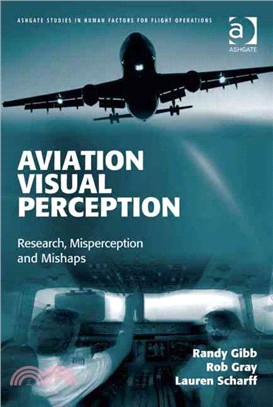
This text on the role of visual perception in aviation is illustrated with b&w photos. Several chapters link the physical with the psychological in the discussion of the deceptive nature of visual cues owing to the expectations of the pilot. Chapter topics include the physiology of visions and visual processing and body perception, the role of basic visual functions in aviation, pilot perception of cues used for visual flying, research on cues used for visual flying, and spatial disorientation (illusions and misperceptions). The book concludes with a discussion of aviation mishaps due to misperception of visual cues, and a look at technological enhancements to visual perception. Gibb teaches in the Behavioral Science and Leadership Department at the US Air Force Academy. Annotation c2010 Book News, Inc., Portland, OR (booknews.com)
作者簡介
Colonel Randy Gibb has served in the United States Air Force since 1986 after earning his commission and Bachelor of Science degree as a Distinguished Graduate from the United States Air Force Academy. He has flown more than 3,400 hours in the following aircraft: Instructor/Evaluator pilot Northrop T-38 Talon, Instructor/Evaluator pilot Lockheed C-5 Galaxy, Instructor pilot T-3 Firefly, Aircraft Commander Learjet C-21, Instructor/Evaluator pilot Raytheon Beechcraft 400 T-1 Jayhawk, and Instructor T-52 Diamond 40. Colonel Gibb's graduate education includes Master of Science in Engineering, Industrial Engineering - Human Factors, Arizona State University, 1996, Master of Arts in National Security and Strategic Studies, Naval Command and Staff College, Newport RI, 2000, and a PhD in Industrial Engineering - Human Factors, Arizona State University, 2007. Col. Gibb had two flying unit commander positions: he led the 84th Airlift Flight, Peterson AFB, C-21 unit as well as the 99th Flying Training Squadron, Randolph AFB, T-1 unit. He is currently an Assistant Professor and Deputy Department Head, Behavioral Sciences & Leadership Department, United States Air Force Academy teaching classes in human factors, engineering psychology, and introductory psychology. Rob Gray is at the University of Birmingham, UK. He obtained his M.S. and Ph.D. in Experimental Psychology from York University, Canada. After earning his Ph.D. he worked for three years as a Research Scientist with Nissan Research & Development conducting research on driving safety. Since 2002 he has worked as a part-time Research Psychologist with the U.S. Air Force working primarily on flight simulator design. At ASU he directs the Perception & Action Laboratory which investigates visual cues used by pilots for tasks such as landing and low-altitude flight. He has authored 36 journal articles, 17 conference papers, and 7 book chapters. In 2007 he received the American Psychological Association (APA) Distinguished Scientific Award for Early Career Contribution to Psychology and the APA Division 21 Earl Alluisi Award for Early Career Achievement in the Field of Applied Experimental & Engineering Psychology. Lauren Scharff is the Director for the Scholarship of Teaching and Learning and a Professor in the Department of Behavioral Sciences and Leadership at the United States Air Force Academy. Prior to that she was a Professor in the Department of Psychology at Stephen F. Austin State University, where she worked since 1993. She completed her Ph.D. in Human Experimental Psychology (Visual Perception) in December, 1992 from the University of Texas at Austin. She teaches introductory psychology, research methods, biopsychology, and perception courses at the undergraduate and graduate levels, and has won several teaching awards. Her research interests have included depth perception, visual search, text readability, and the human factors of web site design, although her students continually shift her research efforts to new directions. She has also collaborated with researchers at NASA-Ames Research Center to create a metric to predict text readability, including conditions that apply to head-up displays.