商品簡介
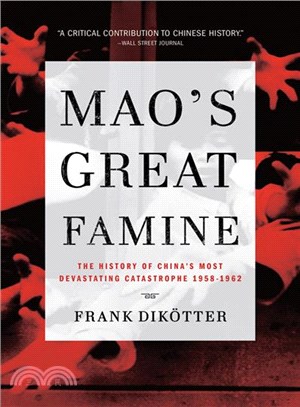
""Between 1958 and 1962, China descended into hell. Mao Zedong threw his country into a frenzy with the Great Leap Forward, an attempt to catch up with and overtake Britain in less than fifteen years. The experiment ended in the greatest catastrophe the country had ever known, destroying tens of millions of lives." So opens Frank Dikotter's astonishing, riveting, magnificently detailed chronicle of an era in Chinese history much speculated about but never before fully documented because access to Communist Party archives has long been restricted to all but the most trusted historians. However, a new archive law has opened up thousands of central and provincial documents that "fundamentally change the way one can study the Maoist era."" "Dikotter makes clear, as nobody has before, that far from being the program that would lift the country among the world's superpowers and prove the power of communism, as Mao imagined, the Great Leap Forward propelled the country in the other direction. It became not onlyone of the most deadly mass killings in human history---at least 45 million people were worked, starved, or beaten to death---but also the greatest demolition of real estate in history, as up to one third of all housing was turned into rubble. The experiment was a catastrophe for the natural world as well, as the land was savaged in the maniacal pursuit of steel and other industrial accomplishments." "In a powerful meshing of exhaustive research in Chinese archives and narrative drive, Dikotter for the first time links up what happened in the corridors of power---the vicious backstabbing and bullying tactics that took place among party leaders---with the everyday experiences of ordinary people, giving voice to the dead and disenfranchised. His magisterial account recasts the history of the People's Republic of China."--BOOK JACKET.
作者簡介
Frank Dikotter is Chair Professor of Humanities at the University of Hong Kong and Professor of the Modern History of China at the School of Oriental and African Studies, University of London. He is a key proponent of studying the history of China in global perspective, and has published a series of innovative books, from his classic The Discourse of Race in Modern China (Univ. Stanford Press 1992) to the controversial Narcotic Culture: A History of Drugs in China (Univ. Chicago Press 2004). He lives in Hong Kong.