商品簡介
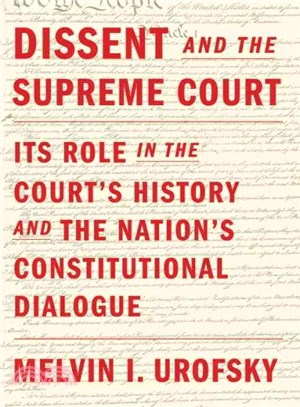
From the revered judicial authority—author of Louis D. Brandeis, Division and Discord, andSupreme Decisions—a major book that looks at the role of dissent in the Supreme Court and the meaning of the Constitution through the greatest and longest lasting (226 years) public policy debate in the country's history, among members of the Supreme Court, between the Court and the other branches of government, and between the Court and the people of the United States.
Melvin Urofsky writes of the necessity of constitutional dialogue as one of the ways in which we as a people reinvent and reinvigorate our democratic society. InDissent and the Supreme Court, he explores the great dissents throughout the Court's 226-year-history. He discusses in detail the role the Supreme Court has played in helping to define what the Constitution means, how the Court's majority opinions have not always been right, and how the dissenters, by positing alternative interpretations, have initiated a critical dialogue about what a particular decision should mean. This dialogue, Urofsky writes, is sometimes resolved quickly; other times it may take decades before the Court adjusts its position. Louis Brandeis's dissenting opinion about wiretapping became the position of the Court four decades after it was written. The Court took six decades to adopt the dissenting opinion of the first Justice Harlan inPlessy v. Ferguson (1896)—that segregation on the basis of race violated the Constitution—in its decision inBrown v. Board of Education (1954).
(With black-and-white illustrations throughout.)
作者簡介
MELVIN I. UROFSKY is professor of law and public policy and a professor emeritus of history at Virginia Commonwealth University and was the chair of its history department. He is the editor (with David W. Levy) of the five-volume collection of Louis Brandeis’s letters, as well as the author of American Zionism from Herzl to the Holocaust andLouis D. Brandeis. He lives in Gaithersburg, Maryland.