商品簡介
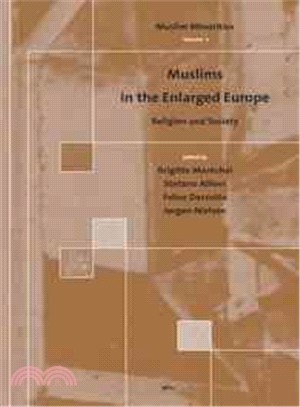
Social scientists sketch the main characteristics of European Islam, primarily as it has developed since the late 1950s when immigrants began arriving in Europe in greater numbers from Islamic countries in Asia and Africa. After an introduction to the history and statistics, they analyze the process of constructing Islam in Europe through such means as belonging and modalities of instruction; the legal status of Muslims, and particularly Muslim family laws, in the legislation and courts of European states; and forms of Islam's inclusion in European society in such dimensions as the media, relations between religions, and economics. A final chapter discusses the situation after the 2001 attacks on the US. Annotation (c) Book News, Inc., Portland, OR (booknews.com)
作者簡介
Brigitte Marechal is graduated in Political Science and Islamology (Louvain, IFEAD-Damas). She is Research assistant at the University of Louvain, preparing a thesis on the Muslim Brothers in Europe, she coordinatedA guidebook on Islam and Muslims in the wide Contemporary Europe (Academia, 2002)Stefano Allievi, Ph.D. in Sociology, is Professor of Sociology at the University of Padova. He publishedLa sfida dell'immigrazione (EMI, 1991), Les convertis a l'islam (L'Harmattan, 1998), Muslim Networks and Transnational Communities in and across Europe(Brill, 2003, with J. Nielsen).Felice Dassetto, Ph.D. in Sociology and Socio-Anthropology of Islam (Catholic University of Louvain). Among others, he wroteLa construction de l'islam europeen (L'Harmattan, 1996), Islamic Words. Individuals, Societies and Discourse in Contemporary European Islam (Maisonneuve-Larose, 2000).Jorgen Nielsen, Ph.D., is Professor of Islamic studies at the University of Birmingham, Director of Graduate Institute for Theology and Religion. Among others, he has publishedMuslims in Western Europe (Edinburgh University Press, 1995), Towards a European Islam (MacMillan, 1999).