商品簡介
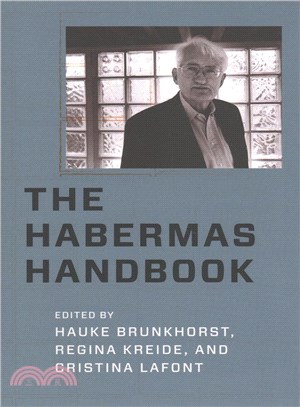
Jürgen Habermas is among the most influential philosophers of our time. His diagnosis of contemporary society and concepts such as the public sphere, communicative rationality, and cosmopolitanism have influenced virtually all academic disciplines, spurred political debates, and shaped intellectual life in Germany and beyond for more than fifty years. In The Habermas Handbook, leading Habermas scholars elucidate his thought, providing essential insight into his key concepts, the breadth of his work, and his influence across politics, law, the social sciences, and public life.
This volume offers a comprehensive overview and in-depth analysis of Habermas's work in its entirety. Opening by examining his intellectual biography, it goes on to illuminate the social and intellectual context of Habermasian thought, such as the Frankfurt School, speech-act theory, and contending theories of democracy. The Handbook provides an extensive account of Habermas's individual texts, ranging from his dissertation on Schelling to his most recent writing about Europe. It illustrates the development of his thought and its not infrequently controversial reception while elaborating the central ideas of his work. The book also provides a glossary of key terms and concepts, making the complexity of Habermas's thought accessible to a broad readership.
作者簡介
Hauke Brunkhorst is professor of sociology and head of the Institute of Sociology at the European University–Flensburg. His books include Adorno and Critical Theory (1999); Solidarity: From Civic Friendship to a Global Legal Community (2005); and Critical Theory of Legal Revolutions: Evolutionary Perspectives (2014).
Regina Kreide is professor of political theory and the history of ideas at the Justus Liebig University of Giessen. She is the coauthor of Transformation of Democracy: Crisis, Protest, and Legitimation (2015) and The Power Dynamics of Securitization (2017).
Cristina Lafont is professor of philosophy at Northwestern University. She is the author of The Linguistic Turn in Hermeneutic Philosophy (1999); Heidegger, Language, and World-Disclosure (2000); and Global Governance and Human Rights (2012) and coeditor of Critical Theory in Critical Times: Transforming the Global Political and Economic Order (Columbia, 2017).