


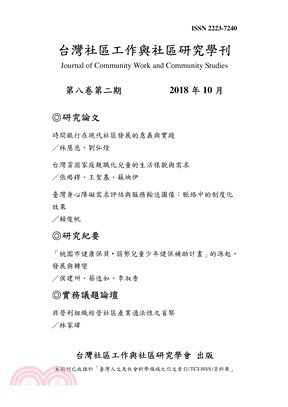
◎ 研究論文
時間銀行在現代社區發展的意義與實踐
/林慧慈、劉弘煌
台灣貧困家庭親職化兒童的生活樣貌與需求
/張緡鏐、王聖基、蘇映伊
臺灣身心障礙需求評估與服務輸送圖像:脈絡中的制度化效果
/賴俊帆
◎ 研究紀要
「桃園市健康保貝.弱勢兒童少年補助計畫」的源起、發展與轉變
/侯建州、蔡逸如、李淑香
◎實務議題論壇
非營利組織經社區產業適法性之省察
/林家緯
英文目次
Journal of Community Work and Community Studies
Vol. 8, No. 2, October 2018
◎ Research Articles
Interpretation and Practice of Time bank in Community
Development
/Hui-Tzu Lin, Horng-Hwang Liou
The Situation and Needs of the Parentified Children in the
Needy Families in Taiwan
/Sheng-Chi Wang, Inn-Ie Su, Min-Liu Chang
The Needs Assessment and Service Delivery for the Disabled
in Taiwan: Effects of Institutionalization in Contexts
/Edward Chun-Fan Lai
◎Research Articles
The Origin, Development and Transformation of “Taoyuan
City Health Insurance Program for Children and Youths:
Premium Subsidies Project of National Health Insurance for
Disadvantaged Children and Youths”
/Chien-Chou Hou, Yi-Ju Tsai, Shu-Hsiang Lee
◎Practice Forum
On the Legitimacy of Non-profit Organizations Operating
Community Enterprise
/Chia-Wei Lin
節錄自〈時間銀行在現代社區發展的意義與實踐〉/林慧慈、劉弘煌
中文摘要
2014年衛福部補助台灣社會福利學會辦理的「全國社區換工推動及換工平台建構計畫」(換工計畫)以時間銀行為模型,試圖結合台灣早期農村社會的互助換工文化進行,本研究以連續參與該計畫兩年的社區為對象,選出三個地理位置與社區型態皆相異的台北吉慶社區、高雄文賢社區,以及花蓮司邁爾社區,使用質性研究的訪談法進行資料蒐集,一共訪談 11 位社區代表。
研究發現,在文化層面,時間銀行與傳統換工概念的結合並不順暢,對於互助精神的理解需要更細膩的考量,包含族群、地區與世代差異;在操作層面,服務交換項目多屬日常生活瑣事,讓人印象深刻與驚喜的傾向於技藝、專業性服務;在群組層面,社區皆面臨多為女性、退休者參與的狀況,使得群組豐富性與社會資本發展受限。在未來拓展上,存在熟悉信任程度與風險責信的疑慮,跨域合作時,管理、經費與界限等問題也隨之浮出檯面。
關鍵字:時間銀行、互助、社區發展
Interpretation and Practice of Time bank in Community Development
Hui-Tzu Lin
Graduate Student, Department of Social Work, Shih Chien University
Horng-Hwang Liou
Associate Professor, Department of Social Work, Shih Chien University
Abstract
Although people used different terms for mutual aid practice in the past, the concept and practice of labor exchange has been embedded in the agriculture society in Taiwan for a very long time. As we enter the era of industry and information the traditional connection and trust is being challenged. The government funded experimental program combined with the traditional labor change and the concept of time bank aim to restore the mutual aid spirit in the community held from 2014 to 2015. The nationwide experimental program took place among different communities. The purpose of the study was to investigate the meaning and practice of time bank to community development in Taiwan. The study sample was purposely selected from communities that have participated in the experimental program for 2 consecutive years. Including Gi-Chin Community located in Taipei, Wen-Sian Community located in Kaohsiung and Smile Community located in Hualien. In total 11 community leaders and program participants were selected and interviewed in depth.
The findings of the study were as follow: 1. From a cultural aspect: The connection between the concept of time bank and that of labor exchange (Hwan-Gung,換工) was not smooth. The combination of concept and practice needs more delicate considerations with regard to ethnic, area, and generation differences.
2. From the contents of labor exchange aspect: The content for exchange consisted mainly of daily chores, it was easy and convenient for helpers and accepting helpers when needed. Professional or technical jobs like cutting hair, sewing, and building houses were especially welcomed and a source of surprise. The participants expressed that mutual aid among community members was usual not just because of the experimental program.
3. From the participant aspect: The participants were manly female and retired. It limited the richness and scope for the future development of labor change practice. As the scope of the groups increase the trust level between people decrease. It brings a management problem once the community boundary is crossed.
Keywords: Time Bank, Mutual Aid, Community Development
壹、前言
從 1994 年行政院文化建設委員會提出「社區總體營造」、2003 年「新故鄉社區營造計畫」,到 2005 年的「台灣健康社區六星計畫」,除了參與部會的提升、計畫與預算的增加,營造內容也從改變社區的生活空間、文化環境擴大到以產業發展、社福醫療、社區治安、人文教育、環境景觀、環保生態等六大面向作為社區發展的目標,使得社區工作關注的價值更加多元。不過黃源協(2010)建議在政策面必須要導正「重硬體(物質)、輕軟體(人文)」的偏頗發展,以營造社區社會資本成為社區營造與發展的基礎,廖嘉展(2012)也指出政策上以硬體為主軸發展的社區營造,社區僅獲得資源,居民自主性卻未被培養出來,喪失公民社會的價值。為改善這樣的狀況,潘淑滿(2000)認為由於都市社區自然型態較不完整、生活步調與空間造成的居民間的冷漠與疏離性,人們較難以對所居住的地理社區產生認同,建議採取議題導向式的社區工作,而非僅以行政地理區域作為社區營造的單元,議題式的社區工作有助於居民彼此之間的互動、凝聚社區意識,重新尋回人與土地的連結。時間銀行作為社區議題的一種形式,屬於社區總體營造實際行動的一環,是居民們起身投入社區、實踐理想、創造居民共融的機會。
為改善多數台灣社區組織以里做為單元,與村里組織範圍的重疊,不利於強調資源整合的「福利社區化」(蔡宗翰,2012),內政部於 2005 年以「生活共同圈」為理念,推出「福利社區化社區旗艦競爭型計畫」,計畫第一階段(第一至二年)的子方案中包含北投人力時間銀行,但人力時間銀行因時間交換普及化的推行過程困難重重,至第二階段(第三年)便停止推動。北投人力時間銀行的計畫雖然以失敗告終,卻開啟了日後以互助概念開展社區工作的機會,也就是換工計畫。
因此,希望藉由此研究,探討以互助為導向的社區工作模式,瞭解參與衛福部換工實驗計畫的社區之施行經驗,在探尋換工計畫執行的同時,也從社區實務經驗中取經,多方地尋找時間銀行在台灣適合的運作方式,衍生出的研究問題如下:
一、互助文化在不同時空中的意義為何,如何轉換?
二、吉慶、文賢與司邁爾三個社區參與換工計畫的經驗為何?
三、換工經驗是否有助於社區社會資本的培養?其對於台灣時間銀行的本
土化發展有何啟發?
期待透過本研究發掘促進社區融合、理念建構、永續發展的要素,使得台灣時間銀行的本土化歷程能更加明確,改變社區營造輕軟體、重硬體的現象,為台灣的社區工作尋找新的可能。
為了保護您的權益,「三民網路書店」提供會員七日商品鑑賞期(收到商品為起始日)。
若要辦理退貨,請在商品鑑賞期內寄回,且商品必須是全新狀態與完整包裝(商品、附件、發票、隨貨贈品等)否則恕不接受退貨。











