商品簡介
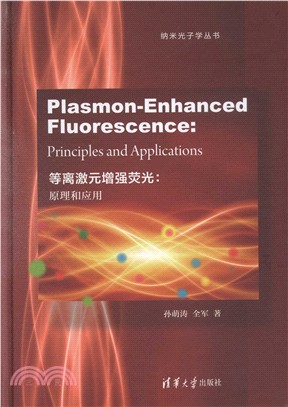
本書將從原理和應用兩個方面詳細介紹多種環境下的等離激元增強熒光。基於局域表面等離激元共振的等離激元能提供熒光所需要電子和能量,在表面等離激元增強熒光,針尖增強熒光光譜,表面等離激元增強上轉換熒光材料,表面等離激元增強的共振熒光能轉移的過程中發現等離激元能選擇性增強分子或材料體系的熒光。
作者簡介
孫萌濤,教授,主要從事基於表面等離激元增強的分子拉曼光譜的實驗和理論研究。研發高真空針尖增強拉曼和熒光光譜儀,實現目標分子拉曼光譜的超靈敏檢測,並揭示表面等離激元增強拉曼光譜的物理和化學機制。以通訊作者(或第一作者)在國際重要學術期刊上發表SCI 論文超過150 篇(其中ESI 高引論文8篇)。所有論文引用約4800多次,H-index 36。Researcher ID: B-1131-2008。10次應邀在國際重要期刊撰寫本領域的綜述。應邀撰寫英文專著(科學出版社)2 本(第一作者)。2016 年,獲遼寧省科學技術(自然科學)二等獎(個人第二)。專著:1. Mengtao Sun, et al., Photoinduced Electron Transfer in organic Solar Cell: Principle and Applications, 科學出版社, 2017年. 2. Mengtao Sun, et al., Tip-enhanced Raman and fluorescence spectroscopy, 科學出版社, 2017年.
目次
CONTENTS
PlasmonEnhanced Fluorescence: Principles and Applications
CONTENTS
Chapter ⅠIntroduction
References
Chapter ⅡPhysical Mechanism of PlasmonEnhanced Fluorescence
2.1Introduction
2.2The principle of PEF
References
Chapter ⅢPlasmonEnhanced Fluorescence
3.1Introduction
3.2PEF from periodical metallic plasmonic nanostructures
3.2.1PEF from nanograting substrate
3.2.2PEF from nanohole arrays substrate
3.2.3PEF from nanoparticle arrays substrate
3.2.4PEF from nanorod arrays substrate
3.3PEF from nonperiodical metallic plasmonic nanostructure
3.3.1PEF from metallic silver island substrate
3.3.2PEF from metallic fractallike substrate
3.3.3PEF from deposited metallic nanoparticle substrate
3.4The wavelength and spacer effect towards the fluorescence
enhancement
3.5Conclusion and prospect
References
Chapter ⅣTipEnhanced Fluorescence
4.1Introduction
4.2Experimental works on tipenhanced fluorescence
4.3Theoretical calculations on tipenhanced Raman
spectroscopy
4.4Results and discussion
4.5Conclusion and outlook
References
Chapter ⅤPlasmonEnhanced Upconversion Photoluminescence:
Physical Mechanism and Applications
5.1Introduction
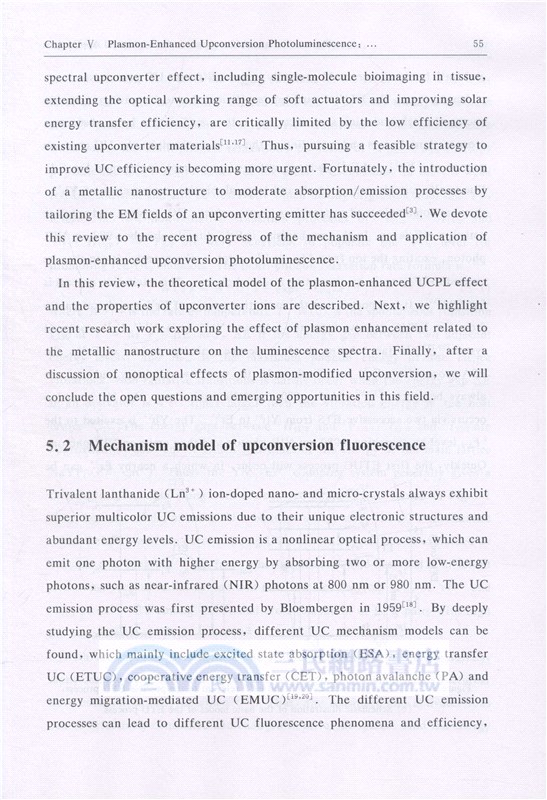
5.2Mechanism model of upconversion fluorescence
5.3Plasmonenhanced upconversion
5.3.1Plasmonenhanced upconversion photoluminescence
from periodic plasmonic nanostructures
5.3.2Plasmonenhanced upconversion photoluminescence
from nonperiodic plasmonic nanostructures
5.4Plasmonenhanced from single rareearthdoped
nanoparticles
5.5The applications of plasmonenhanced UC luminescence
5.6Conclusion
References
Chapter ⅥTimeResolved PlasmonEnhanced Fluorescence for
ExcitonPlasmon Interaction
6.1Introduction
6.2Two methods for the excitonplasmon coupling
6.2.1The first method
6.2.2The second method
6.3Conclusion
References
Chapter ⅦPlasmonEnhanced Fluorescence Resonance Energy Transfer
7.1Introduction
7.2Fluorescence resonance energy transfer
7.2.1The definition and physical mechanism of FRET
7.2.2Methods to measure FRET efficiency
7.2.3Applications of FRET
7.3Plasmonenhanced fluorescence
7.3.1The principle of PEF
7.3.2Principle of PEFRET
7.3.3Application of PEFRET
7.4Summary
References
ACKNOWLEDGEMENTS