商品簡介
本書由台灣學者詩人林明理精闢的解讀,並發表於中國大陸的文學院學報及其它刊物。全書由南開大學張智中教授翻譯完成,以期海內外讀者更深入瞭解書裡的每位學者或作家的創作內涵。詩歌評論包括外國詩人艾蜜莉•狄金森Emily Dickinson、普希金、非馬以及華人陳義海、魯迅、張智中、吳開晉、沈鵬、周夢蝶、周世輔、星雲大師、鄭愁予、蔡輝振、梁欣榮、陳滿銘、鍾玲、顧敏、林亨泰、杜國清、楊宗翰、許達然、胡爾泰、李若鶯、高準、東行等32篇,是本優秀的讀本與教材。
作者簡介
學者詩人林明理博士(1961- ),臺灣雲林縣人,法學碩士、榮譽文學博士。她曾任教於大學,是位詩人評論家,擅長繪畫及攝影,著有詩集,散文、詩歌評論等文學專著39本書,包括在義大利合著的譯詩集4本。其詩作被翻譯成法語、西班牙語、義大利語、俄語及英文等多種,作品發表於報刊及學術期刊等已達2400篇。中國學刊物包括《南京師範大學文學院學報》等多篇。
張智中,天津市南開大學外國語學院教授、博士研究生導師、翻譯系主任,中國翻譯協會理事,中國英漢語比較研究會典籍英譯專業委員會副會長,天津師範大學跨文化與世界文學研究院兼職教授,世界漢學‧文學中國研究會理事兼英文秘書長,天津市比較文學學會理事,第五屆天津市人民政府學位委員會評議組成員、專業學位教育指導委員會委員,國家社科基金專案通訊評審專家和結項鑒定專家,天津外國語大學中央文獻翻譯研究基地兼職研究員,《國際詩歌翻譯》季刊客座總編,《世界漢學》英文主編,《中國當代詩歌導讀》編委會成員,中國當代詩歌獎評委等。已出版編、譯、著120餘部,發表學術論文130餘篇,曾獲翻譯與科研多種獎項。漢詩英譯多走向國外,獲國際著名詩人和翻譯家的廣泛好評。譯詩觀:但為傳神,不拘其形,散文筆法,詩意內容;將漢詩英譯提高到英詩的高度。
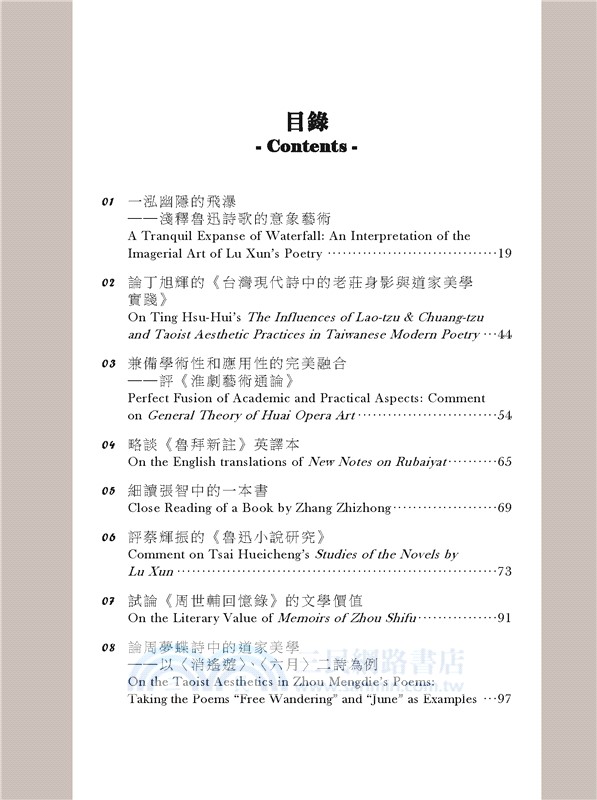
目次
01 一泓幽隱的飛瀑──淺釋魯迅詩歌的意象藝術
A Tranquil Expanse of Waterfall : An Interpretation of the Imagerial Art of Lu Xun’s Poetry ···19
02 論丁旭輝的《台灣現代詩中的老莊身影與道家美學實踐》
On Ting Hsu-Hui’s The Influences of Lao-tzu & Chuang-tzu and Taoist Aesthetic Practices in Taiwanese Modern Poetry ··· 44
03 兼備學術性和應用性的完美融合──評《淮劇藝術通論》
Perfect Fusion of Academic and Practical Aspects : Comment on General Theory of Huai Opera Art ···54
04 略談《魯拜新註》英譯本
On the English translations of New Notes on Rubaiyat ·········· 65
05 細讀張智中的一本書
Close Reading of a Book by Zhang Zhizhong ····················· 69
06 評蔡輝振的《魯迅小說研究》
Comment on Tsai Hueicheng’s Studies of the Novels by Lu Xun ···73
07 試論《周世輔回憶錄》的文學價值
On the Literary Value of Memoirs of Zhou Shifu ················ 91
08 論周夢蝶詩中的道家美學──以〈消遙遊〉、〈六月〉二詩為例
On the Taoist Aesthetics in Zhou Mengdie’s Poems : Taking the Poems “Free Wandering” and “June” as Examples ····················· 97
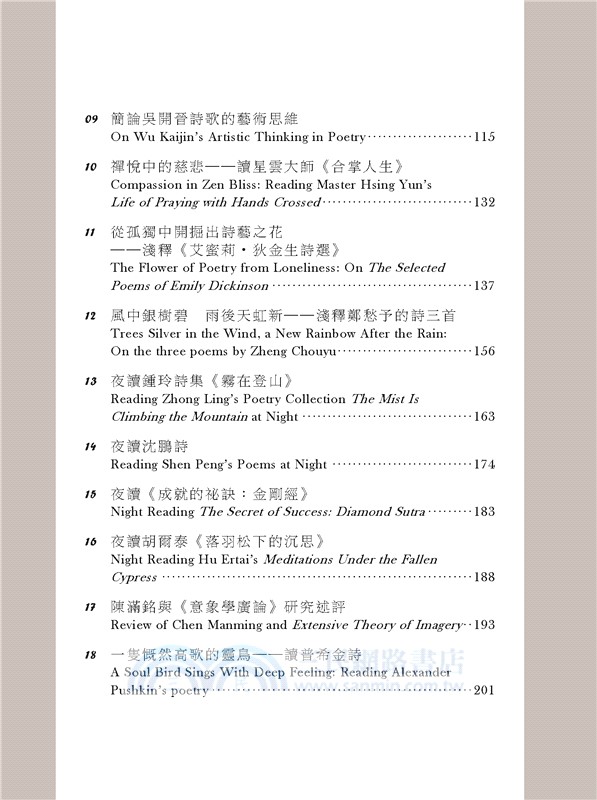
09 簡論吳開晉詩歌的藝術思維
On Wu Kaijin’s Artistic Thinking in Poetry ····················· 115
10 禪悅中的慈悲──讀星雲大師《合掌人生》
Compassion in Zen Bliss: Reading Master Hsing Yun’s Life of Praying with Hands Crossed ···132
11 從孤獨中開掘出詩藝之花──淺釋《艾蜜莉‧狄金生詩選》
The Flower of Poetry from Loneliness : On The Selected Poems of Emily Dickinson ···137
12 風中銀樹碧 雨後天虹新──淺釋鄭愁予的詩三首
Trees Silver in the Wind, a New Rainbow After the Rain: On the three poems by Zheng Chouyu ···156
13 夜讀鍾玲詩集《霧在登山》
Reading Zhong Ling’s Poetry Collection The Mist Is Climbing the Mountain at Night ···163
14 夜讀沈鵬詩
Reading Shen Peng’s Poems at Night ·········174
15 夜讀《成就的祕訣:金剛經》
Night Reading The Secret of Success: Diamond Sutra ········· 183
16 夜讀胡爾泰《落羽松下的沉思》
Night Reading Hu Ertai’s Meditations Under the Fallen Cypress ···188
17 陳滿銘與《意象學廣論》研究述評
Review of Chen Manming and Extensive Theory of Imagery ···193
18 一隻慨然高歌的靈鳥──讀普希金詩
A Soul Bird Sings With Deep Feeling: Reading Alexander Pushkin’s poetry ···201
19 杜國清詩歌的意象節奏
The Image Rhythm of Du Guoqing’s Poems ···················· 218
20 時空的哲人──淺析林亨泰的詩歌藝術
Space-time Philosopher: Brief Analysis of Lin Hengtai’s Poetic Art ···230
21 崇高的樸素──讀《高準游踪散紀》
Sublime Simplicity: Reading Gao Zhun’s Travel Notes ········ 246
22 陳義海詩歌的思想藝術成就
The Ideological and Artistic Achievements of Chen Yihai’s Poetry ·······256
23 尋找恬淡中的感性──以《魯迅圖傳》為視角
Seeking Sensibility in Tranquility: From the Perspective of Lu Xun’s Illustrated Biography ···271
24 評吳鈞的《魯迅詩歌翻譯傳播研究》
Comments on Wu Jun’s A Study of the Translation and Communication of Lu Xun’s Poems ···282
25 簡論許達然詩的通感
On the Synaesthesia in Xu Daran’s Poems ······················ 289
26 簡論非馬的散文創作──讀《不為死貓寫悼歌》有感
A Brief Analysis of William Marr’s Creative Essay Writing : On reading I Will Never Write a Dirge for a Dead Cat ······················ 304
27 讀東行詩集《水果之詩》
Reading Dong Xing’s Poetry Collection Poems of Fruits ······ 315
28 生命風景的畫冊──讀李若鶯詩集《謎‧事件簿》
A Picture Album of the Scenery of Life: Reading Li Ruoying’s Poetry Collection Mystery Incident Book ······················324
29 讀《廣域圖書館》──兼述顧敏與圖書館管理的理論與實務
Reading Wide Area Library : Discussing Karl Ku and the Theory and Practice of Library Management ······················333
30 一隻勇毅的飛鷹──讀楊宗翰《隱於詩》
A Courageous Eagle: Reading Yang Zonghan’s Hidden in Poetry ············346
31 《華痕碎影》中蘊含的魯迅審美思維
Lu Xun’s Aesthetic Thoughts in Bits & Pieces of Memories ·· 352
32 評黃淑貞《以石傳情──談廟宇石雕意象及其美感》
Comments on Huang Shuzhen’s Using Stone to Express Emotions: On the Imagery and Aesthetics of Temple Stone Sculptures ···············358
04 略談《魯拜新註》英譯本
On the English translations of New Notes on Rubaiyat
書摘/試閱
《魯拜集》(The Rubaiyat of Omar khayyam)是波斯十一世紀的詩人奧瑪•珈音(Omar Khayyám,1048-1122)的四行詩集,其特徵是每首四行,一、二、四行押韻,第三行通常不押韻,跟中國的絕句頗為相似。此書在華人世界的譯本以十九世紀英國作家愛德華•費滋傑羅(Edward Fitzgerald)的英譯本,廣泛流傳。《魯拜》原名Rubaiyat,意「四行詩」,非指一首分成一百零一節的長詩;而是每一首都有獨立存在的價值,且佳作如林。他的詩大部分關於命運、死亡、享樂、不朽,用筆墨來探索來世及宗教,意境高遠,數百年來啟發無數讀者。
奧瑪•珈音是個詩哲、著名的天文學家、數學家,一生研究各門學問,尤精天文學。他留下詩集《柔巴依集》(Rubaiyat,又譯《魯拜集》),是寫其思想深度與世界,歌咏天意無常、生命短暫、美好事物如過眼雲煙、命運難以捉摸等體悟,因而是部人生感悟的詩化結晶。繼胡適、郭沫若、聞一多、徐志摩、吳劍嵐、孫毓堂等人英譯衍譯本之後,台大外文系梁欣榮教授,自幼受父親的啟蒙,愛讀舊詩,自美國德州A&M大學英美文學博士畢業後,在教授之餘,用畢生的心血創作了大量豐盈的著作,獲梁實秋翻譯獎、林語堂翻譯獎及台大文學翻譯獎評審等殊榮。他在2013年亦推出譯本《魯拜新詮》,以古典七言絕句形式重新詮釋《魯拜集》,當代學者給予極高評價,在翻譯內容上也有較大的延伸。
在諸家翻譯的原著中,梁欣榮的《魯拜新詮》非但強化了文本中的詩體,以仰視的角度出現在翻譯家的平台上,讓讀者看到更多的是他深厚的文學底子,得以「凝視」奧瑪•珈音詩歌裡最深層的寂寞,並帶著一種對他生命價值的敬意,而我們也確定了這位不朽的詩人生存的價值。
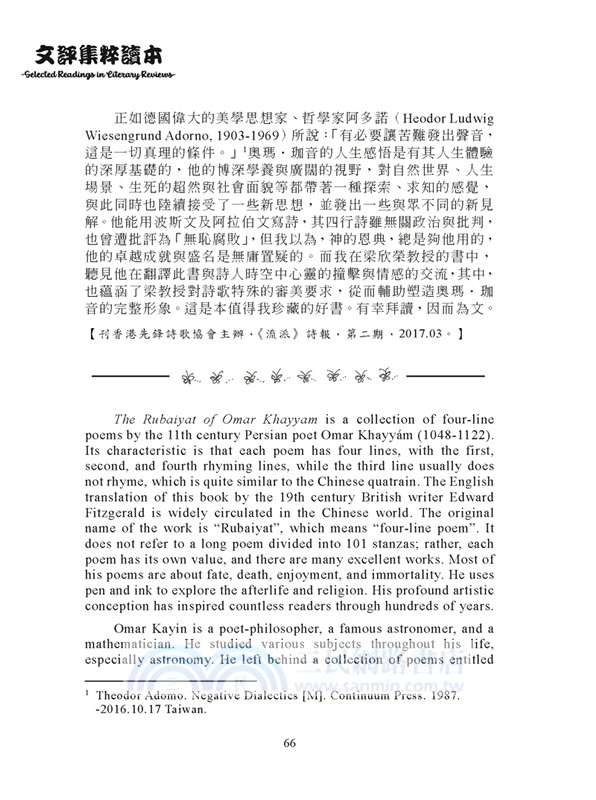
正如德國偉大的美學思想家、哲學家阿多諾(heodor Ludwig Wiesengrund Adorno1903-1969)所說:「有必要讓苦難發出聲音,這是一切真理的條件。」奧瑪•珈音的人生感悟是有其人生體驗的深厚基礎的,他的博深學養與廣闊的視野,對自然世界、人生場景、生死的超然與社會面貌等都帶著一種探索、求知的感覺,與此同時也陸續接受了一些新思想,並發出一些與眾不同的新見解。他能用波斯文及阿拉伯文寫詩,其四行詩雖無關政治與批判,也曾遭批評為「無恥腐敗」,但我以為,神的恩典,總是夠他用的,他的卓越成就與盛名是無庸置疑的。而我在梁欣榮教授的書中,聽見他在翻譯此書與詩人時空中心靈的撞擊與情感的交流,其中,也蘊涵了梁教授對詩歌特殊的審美要求,從而輔助塑造奧瑪•珈音的完整形象。這是本值得我珍藏的好書。有幸拜讀,因而為文。
【刊香港先鋒詩歌協會主辦,《流派》詩報,第二期, 2017.03。】
The Rubaiyat of Omar Khayyam is a collection of four-line poems by the 11th century Persian poet Omar Khayyám (1048 -1122). Its characteristic is that each poem has four lines, with the first, second, and fourth rhyming lines, while the third line usually does not rhyme, which is quit e similar to the Chinese quatrain. The English translation of this book by the 19th century British writer Edward Fitzgerald is widely circulated in the Chinese world. The original name of the work is “Rubaiyat”, which means “four -line poem”. It does not refer to a long poem divided into 101 stanzas; rather, each poem has its own value, and there are many excellent works. Most of his poems are about fate, death, enjoyment, and immortality. He uses pen and ink to explore the afterlife and religion. His profo und artistic conception has inspired countless readers through hundreds of years.
Omar Kayin is a poet -philosopher, a famous astronomer, and a mathematician. He studied various subjects throughout his life, especially astronomy. He left behind a collection of poems entitled Rubaiyat, which describes the depth of his thoughts and the world, singing about the impermanence of God’s will, the brevity of life, the fleetingness of beautiful things, and the unpredictability of fate. Therefore, it is a poetic crystallization of his understan ding of life. Following the English translations of Hu Shi, Guo Moruo, Wen Yiduo, Xu Zhimo, Wu Jianlan, Sun Yutang and others, professor Liang Xinrong of the Department of Foreign Languages at National Taiwan University, who was inspired by his fat her to read old poems since childhood, has devoted his life to creating a host of works after graduating from Texas A&M University with a doctorate in British & American literature. He has won the Liang Shiqiu Translation Award, the Lin Yutang Translation Award and the National Taiwan University Literature Translation Award. In 2013, he made a translation, A New Interpretation of the Rubaiyat , which reinterpreted the Rubaiyat in the form of classical seven-character quatrains. Contemporary scholars have given it high praise, and the translation content has also been greatly extended.
Among the original works translated by various people, Liang Xinrong’s A New Interpretation of Rubaiyat not only strengthens the poetic style in the text, but also appears on the platform of the translator from an upward perspective, allowing readers to see more of his profound literary foundation, and to “gaze” at the deepest loneliness in Omar Kayin’s poems, and with a kind of respect for the value of his life, we also confirm the value of the existence of this immortal poet.
As the great German aesthetic thinker and philosopher Adorno (1903-1969) said, “It is necessary to give voice to suffering. This is the condition of all truth.” Omar Kayin’s life is based on his own life experience. His profound knowledge and broad vision have brought him a sense of exploration and knowledge of the natural world, life scenes, the transcendence of life and death, and the social outlook. At the same time, he has gradually accepted some new ideas and put forward some new and different insights. He writes poetry in Persian and Arabic. Although his quatrains have nothing to do with politics and criticism, they have been criticized as “shameless and corr upt”, but I think that God’s grace is always enough for him. His outstanding achievements and fame are beyond doubt. In Professor Liang Xinrong’s book, I heard the collision and emotional exchange between his translation of this book and the poet’s soul in time and sp ace. It also contains Professor Liang’s special aesthetic requirements for poetry, which helps to shape the complete image of Omar Kayin. This is a good book worth collecting, and it is a luck for me to read it and write about it.
【Published in the second issue of School Poetry News, hosted by the Hong Kong Pioneer Poetry Association, March, 2017.】