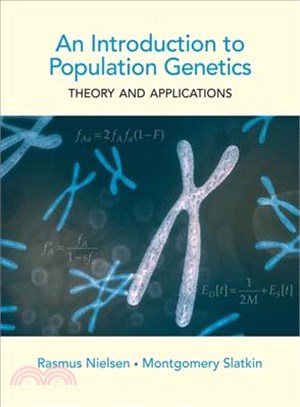
Nielsen and Slatkin (both U. of California-Berkeley) present a textbook they developed in and for a one-semester undergraduate course in population genetics. Students should have some basic knowledge of biology and genetics, they say, and not be afraid of quantitative thinking. Assuming only basic algebra, they introduce some ideas from probability and statistics that are an integral part of modern population genetics. The topics include genetic drift and mutation, population subdivision, selection, the neutral theory and tests of neutrality, and quantitative genetics. Annotation c2013 Book News, Inc., Portland, OR (booknews.com)