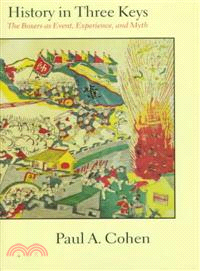
Uses the Boxer Rebellion of 1898-1900, a major Chinese anti-foreign movement, to illuminate contrasts between the accounts of historians, the experiences of participants and witnesses, and myths forme
Serious study of nineteenth- and twentieth-century Chinese history did not really get under way in the United States until after World War II. Since then, scholarly publication has proliferated and a
In this memoir, Paul A. Cohen, one of the West’s preeminent historians of China, traces the development of his work from its inception in the early 1960s to the present, offering fresh perspectives th
When people experience a traumatic event, such as war or the threat of annihilation, they often turn to history for stories that promise a positive outcome to their suffering. During World War II, the
When people experience a traumatic event, such as war or the threat of annihilation, they often turn to history for stories that promise a positive outcome to their suffering. During World War II, the
Since its first publication, Paul A. Cohen's "Discovering History in China" has occupied a singular place in American China scholarship. Translated into three East Asian languages, the volume has beco
Since its first publication, Paul A. Cohen's "Discovering History in China" has occupied a singular place in American China scholarship. Translated into three East Asian languages, the volume has beco