

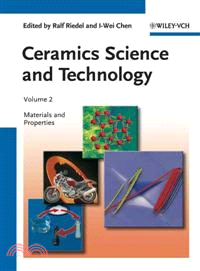
Built on the solid foundations laid down by the 20-volume series Materials Science and Technology, Ceramics Science and Technology picks out this exciting material class and illuminates it from all sides.
Materials scientists, engineers, chemists, biochemists, physicists and medical researchers alike will find this work a treasure trove for a wide range of ceramics knowledge from theory and fundamentals to practical approaches and problem solutions.
List of Contributors.
I. Ceramic Material Classes.
1. Ceramic Oxides (DušanGalusek and Katarína Ghillányová).
1.1 Introduction.
1.2 Aluminum Oxide.
1.3 Magnesium Oxide.
1.4 Zinc Oxide.
1.5 Titanium Dioxide.
1.6 Zirconium Oxide.
1.7 Cerium Oxide.
1.8 Yttrium Oxide.
References.
2. Nitrides (Pavol Šajgalík, Zoltán Lenčéš, and Miroslav Hnatko).
2.1 Silicon Nitride.
2.2 Boron Nitride.
2.3 Aluminum Nitride.
2.4 Titanium Nitride.
2.5 Tantalum Nitride.
2.6 Chromium Nitride
2.7 Ternary Silicon Nitrides.
2.8 Light-Emitting Nitride and Oxynitride Phosphors.
References.
3. Gallium Nitride and Oxonitrides (Isabel Kinski and Paul F. McMillan).
3.1 Introduction.
3.2 Gallium Nitrides.
3.3 Gallium Oxides.
3.4 Gallium Oxonitrides.
3.5 Outlook.
References.
4. Silicon Carbide- and Boron Carbide-Based Hard Materials (Clemens Schmalzried and Karl A. Schwetz).
4.1 Introduction.
4.2 Structure and Chemistry.
4.3 Production and Particles and Fibers.
4.4 Dense Ceramic Shapes.
4.5 Properties of Silicon Carbide- and Boron Carbide-Based Materials.
4.6 Application of Carbides.
References.
5. Complex Oxynitrides (Derek P. Thompson).
5.1 Introduction.
5.2 Principles of Silicon-Based Oxynitride Structures.
5.3 Complex Si-Al-O-N Phases.
5.4 M-Si-Al-O-N Oxynitrides.
5.5 Oxynitride Glasses.
5.6 Oxynitride Glass Ceramics.
5.7 Conclusions.
References.
6. Perovskites (Vladimir Federov).
6.1 Introduction.
6.2 Crystal Structure.
6.3 Physical Properties.
6.4 Chemical and Catalytic Properties.
6.5 Summary.
References.
7. The Mn+1AXn Phases and their Properties (Michel W. Barsoum).
7.1 Introduction.
7.2 Bonding and Structure.
7.3 Elastic Properties.
7.4 Electronic Transport.
7.5 Thermal Properties.
7.6 Mechanical Properties.
7.7 Tribological Properties and Machinability.
7.8 Concluding Remarks.
References.
II. Structures and Properties.
8. Structure-Property Relations (Tatsuki Ohji).
8.1 Introduction.
8.2 Self-Reinforced Silicon Nitrides.
8.3 Fibrous Grain-Aligned Silicon Nitrides (Large Grains).
8.4 Fibrous Grain-Aligned Silicon Nitrides (Small Grains).
8.5 Grain Boundary Phase Control.
8.6 Fibrous Grain-Aligned Porous Silicon Nitrides.
References.
9. Dislocations in Ceramics (Terence E. Mitchell).
9.1 Introduction.
9.2 The Critical Resolved Shear Stress.
9.3 Crystallography of Slip.
9.4 Dislocations in Particular Oxides.
9.5 Work Hardening.
9.6 Solution Hardening.
9.7 Closing Remarks.
References.
10. Defect Structure, Nonstoichiometry, and Nonstoichiometry Relaxation of Complex Oxides (Han-Ill Yoo).
10.1 Introduction.
10.2 Defect Structure.
10.3 Oxygen Nonstoichiometry.
10.4 Nonstoichiometry Re-Equilibration.
References.
11. Interfaces and Microstructures in Materials (Wook Jo and Nong-Moon Hwang).
11.1 Introduction.
11.2 Interfaces in Materials.
11.3 Practical Implications.
11.4 Summary and Outlook.
References.
III. Mechanical Properties.
12. Fracture of Ceramics (Robert Danzer, Tanja Lube, Peter Supancic, and Rajiv Damani).
12.1 Introduction.
12.2 Appearance of Failure and Typical Failure Modes.
12.3 A Short Overview of Damage Mechanisms.
12.4 Brittle Fracture.
12.5 Probabilistic Aspects of Brittle Fracture.
12.6 Delayed Fracture.
12.7 Concluding Remarks.
References.
13. Creep Mechanisms in Commercial Grades of Silicon Nitride (František Lofaj and Sheldon M. Wiederhorn).
13.1 Introduction.
13.2 Material Characterization.
13.3 Discussion of Experimental Data.
13.4 Models of Creep in Silicon Nitride.
13.5 Conclusions.
References.
14. Fracture Resistance of Ceramics (Mark Hoffman).
14.1 Introduction.
14.2 Theory of Fracture.
14.3 Toughened Ceramics.
14.4 Influence of Crack Growth Resistance Curve Upon Failure by Fracture.
14.5 Determination of Fracture Resistance.
14.6 Fatigue.
14.7 Concluding Remarks.
References.
15. Superplasticity in Ceramics: Accommodation-Controlling Mechanisms Revisited (Arturo Domínguez-Rodríguez and Diego Gómez-García).
15.1 Introduction.
15.2 Macroscopic and Microscopic Features of Superplasticity.
15.3 Nature of the Grain Boundaries.
15.4 Accommodation Processes in Superplasticity.
15.5 Applications of Superplasticity.
15.6 Future Prospective in the Field.
References.
IV. Thermal, Electrical, and Magnetic Properties.
16. Thermal Conductivity (Kiyoshi Hirao and You Zhou).
16.1 Introduction.
16.2 Thermal Conductivity of Dielectric Ceramics.
16.3 High-Thermal Conductivity Nonoxide Ceramics.
16.4 Mechanical Properties of High-Thermal Conductivity Si3N4 Ceramics.
16.5 Concluding Remarks.
References.
17. Electrical Conduction in Nanostructured Ceramics (Harry L. Tuller, Scott J. Litzelman, and George C. Whitfield).
17.1 Introduction.
17.2 Space Charge Layers in Semiconducting Ceramics Materials.
17.3 Effect of Space Charge Profiles on the Observed Conductivity.
17.4 Influence of Nanostructure on Charge Carrier Distributions.
17.5 Case Studies.
17.6 Conclusions and Observations.
References.
18. Ferroelectric Properties (Doru C. Lupascu and Maxim I. Morozov).
18.1 Introduction.
18.2 Intrinsic Properties: The Anisotropy of Properties.
18.3 Extrinsic Properties: Hard and Soft Ferroelectrics.
18.4 Textured Ferroelectric Materials.
18.5 Ferroelectricity and Magnetism.
18.6 Fatigue in Ferroelectric Materials.
References.
19. Magnetics Properties of Transition-Metal Oxides: From Bulk to Nano (Polona Umek, Andrej Zorko, and Denis Arčon).
19.1 Introduction.
19.2 Properties of Transition Metal 3d Orbitals.
19.3 Iron Oxides.
19.4 Ferrites.
19.5 Chromium Dioxide.
19.6 Manganese Oxide Phases.
19.7 Concluding Remarks.
References.
Index.
外文書商品之書封,為出版社提供之樣本。實際出貨商品,以出版社所提供之現有版本為主。部份書籍,因出版社供應狀況特殊,匯率將依實際狀況做調整。
無庫存之商品,在您完成訂單程序之後,將以空運的方式為你下單調貨。為了縮短等待的時間,建議您將外文書與其他商品分開下單,以獲得最快的取貨速度,平均調貨時間為1~2個月。
為了保護您的權益,「三民網路書店」提供會員七日商品鑑賞期(收到商品為起始日)。
若要辦理退貨,請在商品鑑賞期內寄回,且商品必須是全新狀態與完整包裝(商品、附件、發票、隨貨贈品等)否則恕不接受退貨。













