商品簡介
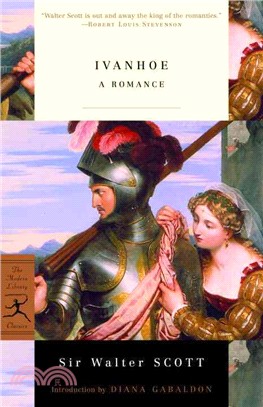
Hailed by Victor Hugo as 'the real epic of our age,' Ivanhoe was an immensely popular bestseller when first published in 1819. The book inspired literary imitations as well as paintings, dramatizations, and even operas. Now Sir Walter Scott's sweeping romance of medieval England has prompted a lavish new television production. In the twelfth century, Sir Wilfred of Ivanhoe returns home to England from the Third Crusade to claim his inheritance and the love of the lady Rowena. The heroic adventures of this noble Saxon knight involve him in the struggle between Richard the Lion-Hearted and his malignant brother John: a conflict that brings Ivanhoe into alliance with the mysterious outlaw Robin Hood and his legendary fight for the forces of good. 'Scott's characters, like Shakespeare's and Jane Austen's, have the seed of life in them,' observed Virginia Woolf. 'The emotions in which Scott excels are not those of human beings pitted against other human beings, but of man pitted against Nature, of man in relation to fate. His romance is the romance of hunted men hiding in woods at night; of brigs standing out to sea; of waves breaking in the moonlight; of solitary sands and distant horsemen; of violence and suspense.' For Henry James, 'Scott was a born storyteller. . . . Since Shakespeare, no writer has created so immense a gallery of portraits.'
作者簡介
Sir Walter Scott, the Scotsman who is often credited with inventing the historical novel and who became the most popular author of his day, was born in Edinburgh on August 15, 1771, into a prosperous middle-class family. He was the fourth surviving child of Walter Scott, a staunchly Presbyterian solicitor, and Anne Rutherford, the well-educated daughter of a professor of medicine. Crippled by polio when he was eighteen months old, Scott spent his early childhood convalescing in the Border country southeast of Edinburgh and became fascinated by folklore of the region. At the age of twelve he entered the high school of Edinburgh to study Latin, Greek, and logic; afterward he pursued courses in law and philosophy. Following a five-year apprenticeship in his father's law office, Scott was admitted to the bar in 1792. Five years lat