商品簡介
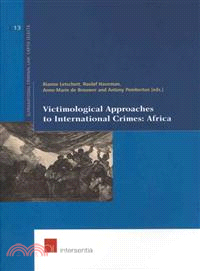
The last decade of the 20th century saw the revival of global efforts aimed at tackling some of the most atrocious crimes of concern to mankind. Legal initiatives at international, regional, and national levels took shape to prevent the commission of genocide, war crimes, and crimes against humanity (international crimes), as well as to punish those most responsible for them. These commendable legal developments had considerable shortcomings in dealing with victims of international crimes. Victims' suffering and needs were hardly considered a priority. The establishment of the International Criminal Court changed this to some extent, providing a more comprehensive framework towards addressing victims' needs through a criminal justice approach. The peculiar situation of victims of international crimes calls for a holistic approach that links various relevant fields, such as traumatic stress, the social psychology of group conflict and resolution, and the psychology and sociology of legal processes. The latter is important in its own right, but also for the ongoing efforts in transitional and international criminal justice, as it can provide the empirical underpinning of the choices and developments in these fields. Transcending the disciplinary divisions in the study of victims of international crimes is the main focus of this volume, which contributes to developing victimological approaches to international crimes. Focusing on the African continent, scholars from different disciplines review the similarities and differences between victims of ordinary crimes and those of genocide, war crimes, and crimes against humanity. As victimological research has mainly focused on the former crimes, the book provides a much-needed and comprehensive overview of the intricacies of victimization by international crimes. This endeavor transcends academic interest, as an approach of this kind is essential to mend societies ravaged by genocide, war crimes, and/or crimes against humanity. (Series: Supranational Criminal Law: Capita Selecta - Vol. 13)
作者簡介
Anne-Marie de Brouwer (PhD, LL.M.) studied Dutch, human rights law and international law at Tilburg University (the Netherlands), La Sapienza (Italy) and the University of Essex (UK). She is currently an Associate Professor in international criminal law at the Department of Criminal Law of Tilburg University, the Netherlands, and a research fellow with the International Victimology Institute Tilburg (INTERVICT). Previously, she was an associate legal officer at the Women's Initiatives for Gender Justice in The Hague.Her main areas of research and interest include international crimes, international criminal law and procedure, international humanitarian law, victims' rights, victimology, sexual violence and transitional justice.She is the co-founder and chair of the Mukomeze Foundation, which aims to improve the lives of women and girls who survived sexual violence during the Rwandan genocide.Prof. dr. Antony Pemberton is Director of Studies and Full Professor of Victimology at the International Victimology Institute Tilburg. He was Researcher at Research for Policy (2000-2002) and Senior staff member/ Scientific adviser at Victim Support the Netherlands in Utrecht (2002-2007).He studied law at the Radboud University Nijmegen (1994-1999) and obtained his PhD at the Tilburg University (2007-2010) entitled "The cross-over. An interdisciplinary approach to the study of victims of crime".