


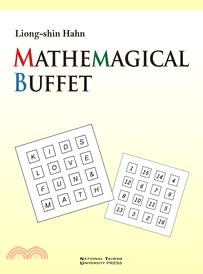


Throughout my many years of teaching at the university level, I frequently enjoyed giving stimulating little talks to secondary-school students (in the U.S. and Taiwan). This book contains detailed accounts of these talks. Because each topic is aimed at a particular grade level, chapters are independent and may be read in any order.
It is unlikely that more than a small fraction of our students will actually use mathematics in their careers. Therefore, we would do well to foster healthy attitudes and worthwhile habits of mind while they are in our care. In particular, I stress
(a) an appreciation of the beauty of mathematics,
(b) acquiring the habit of deep thinking,
(c) the ability to reason logically.
For this purpose, I can't think of a better choice than the revival of Euclidean geometry in our secondary school curriculum. Euclidean geometry contains a wealth of not only wonderful theorems for students to enjoy the beauty of mathematics, but also intriguing and challenging problems to lure students into deep thinking and explorations; not to mention that it provides a fertile ground for training in logical reasoning. In fact, I have heard many people in my generation and earlier who claimed that they enjoyed Euclidean geometry immensely, even though they were not good at algebra. As Albert Einstein said, "If Euclid failed to kindle your youthful enthusiasm, then you were not born to be a scientific thinker."
Mathematics books are not to be "read". They should be worked through with pencil and paper. Looking back on my own experience, I learned mathematics not by reading books, nor by attending lectures. I learned mathematics mainly by solving (or trying to solve) challenging problems; by trying to explore what happens when part of the assumption of the theorem is altered or deleted; by trying to find what it means in simple particular cases; by investigating the converse. In short, by playing around with problems. Furthermore, my experience convinces me that the crux of a great theorem lies often in a simple concrete special case. Consequently, in teaching, I try to emphasize the important particular cases rather than the most general case. And I try my best to expose the motivation behind each move; at the minimum, I try to avoid presenting solutions and proofs as beautiful but "static" finished artifacts.
I believe that mathematics textbooks should emphasize ideas; they should not be mere collections of the facts. My teaching motto is: "Don't try to teach everything. Always leave something for students to explore." Hence I tell my students, "I do the easy part and you do the hard part." Consequently, I am allergic to overweight textbooks trying to include everything. Does anyone really believe students are interested in reading 5-pound, 800-page textbooks with most of the pages filled with repetitions of simple routine drills, ad nauseam? I get the impression that authors of overweight textbooks are more concerned with encyclopedic coverage of topics at the expense of discussing how topics relate to each other. Consequently, students think that mathematics is just a collection of facts, facts to be remembered in order to pass multiple-choice tests. How tragic it is to starve millions of eager young minds by depriving them of being exposed to the beauty and excitement of mathematics!
This book goes against the current trend. I try to present something intriguing that does not yield to well-worn standard approaches, something that involves a spark of ingenuity. The book is now presented to be judged by readers. I cherish the hope that you will enjoy the feast in my Mathemagical Buffet.
L.-s. Hahn
From 17th century to early 20th century, people of various walks in Japan offered their mathematical discoveries on wooden tablets to shrines and temples. Most of the time, it was done for pure enjoyment or to challenge others (but certainly not for college entrance or job promotion). Majority of them were in geometry. To me that is a strong indication that geometry had (and still has) popular appeal to the general public. Thus I find it very tragic that geometry is being de-emphasized in school mathematics nowadays.
--p. 25
Suppose we have 12 table tennis players. Instead of a tournament, during which many pairs of players do not have a chance for a match, the organizer decides on a round robin competition so that every pair of players has a chance to meet. He wants every player to have one match every day so that six matches are played every day. Naturally, it takes eleven days to play all the matches, because each one has 11 opponents. How should he arrange the matches? He is concerned that if not well-planned, some players might find the opponents they needed unavailable in the final days, forcing them to wait and requiring extra days for the competition.
--p.79
Because of the fact that there exist angles (such as 60° angle) that cannot be trisected (using compass and straightedge finitely many times), mathematicians tended to shy away from problems involving trisections of angles. Perhaps that is why the following dandy theorem was discovered only in 1904 by the British geometer Frank Morley (1860 - 1937). The idea in our proof was essentially the one shown to me by Professor John H. Conway of Princeton University, when I (as the director of the New Mexico
Mathematics Contest) invited him to give a talk to the Contest finalists in February 1999.
--p.157
為了保護您的權益,「三民網路書店」提供會員七日商品鑑賞期(收到商品為起始日)。
若要辦理退貨,請在商品鑑賞期內寄回,且商品必須是全新狀態與完整包裝(商品、附件、發票、隨貨贈品等)否則恕不接受退貨。










