商品簡介
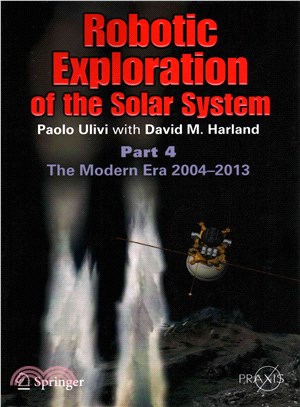
This series of four books marks the 50th anniversary of the start of the “space age,” which opened with the launch of Sputnik in 1957, by providing a comprehensive account of how we have used robotic spacecraft to explore the Solar System. It starts with a review of what we knew - or thought we knew – about the Solar System immediately prior to dispatching the first space probes, and then discusses each project and the results obtained, to progressively explain how our knowledge of the Solar System has increased over the years. “Part 4: The Modern Era 2004 – 2012” focuses on the robotic missions initiated since 2004, including NASA's Mars Reconnaissance Orbiter, the Phoenix Mars lander, the Curiosity rover, the foiled Russian mission to the Martian moon Phobos, the joint NASA-European orbiters and rovers for Mars, and attempts by China, Japan and India to send probes. “Part 4” also discusses missions to other destinations, including the Rosetta, Deep Impact and EPOXI comet missions, the MESSENGER orbiter for Mercury, the European Venus Express orbiter, the troubled Japanese mission to Venus, the Dawn mission to the asteroids Vesta and Ceres, and the New Horizons mission to Pluto. The book concludes with a look ahead to possible future robotic missions and the prospect of sending humans to the Red Planet. It includes comprehensive appendices of data on the missions flown in the period 2004 to 2012, bringing the series up to date.
作者簡介
Paolo Ulivi was born in Florence, Italy and graduated from the Politecnico di Milano University with a thesis on robotics for Mars sample return missions. He works as a consultant in aeropsace structures in Toulouse, France. In his free time, he researches the history of astronautics, astronomy, aeronautics and the Cold War. He is also an amateur astronomer and specializes in Solar System observations. David Harland studied astronomy to degree level, and pursued a career lecturing in computer science, and academic and industrial research. In 1995, David "retired" to resume his interest in space and started to write. He has over two dozen books published to date, a majority of them with Springer/Praxis and several others under contract. These days he considers himself to be an amateur hermit and a professional space historian.