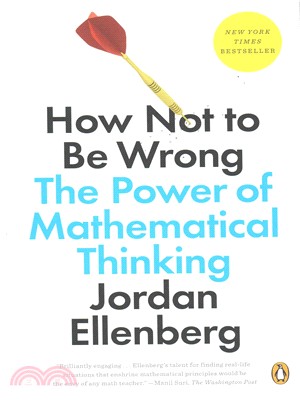
★ 《紐約時報》暢銷書,數學界最會說故事的天才之作
★ 被譽為「數學版《Freakonomics》」,顛覆你對數學的想像
★ 從日常問題到世界難題,一次看懂數學如何影響人生
★ 用幽默拆解複雜思考,讓你學會「不犯錯」的關鍵能力
本書以幽默生動的筆法,揭示數學如何滲透於我們的日常生活,從決策判斷到世界理解,處處可見其影響。作者將艱深理論轉化為易懂故事,帶領讀者學會辨識錯誤與偏誤,培養更精準的思考能力。這不只是一本數學書,更是一套讓你看清世界、做出更好選擇的關鍵工具。
The Freakonomics of math?a math-world superstar unveils the hidden beauty and logic of the world and puts its power in our hands
The math we learn in school can seem like a dull set of rules, laid down by the ancients and not to be questioned. In How Not to Be Wrong, Jordan Ellenberg shows us how terribly limiting this view is: Math isn't confined to abstract incidents that never occur in real life, but rather touches everything we do?the whole world is shot through with it.
Math allows us to see the hidden structures underneath the messy and chaotic surface of our world. It's a science of not being wrong, hammered out by centuries of hard work and argument. Armed with the tools of mathematics, we can see through to the true meaning of information we take for granted: How early should you get to the airport? What does ?public opinion” really represent? Why do tall parents have shorter children? Who really won Florida in 2000? And how likely are you, really, to develop cancer?
How Not to Be Wrong presents the surprising revelations behind all of these questions and many more, using the mathematician's method of analyzing life and exposing the hard-won insights of the academic community to the layman?minus the jargon. Ellenberg chases mathematical threads through a vast range of time and space, from the everyday to the cosmic, encountering, among other things, baseball, Reaganomics, daring lottery schemes, Voltaire, the replicability crisis in psychology, Italian Renaissance painting, artificial languages, the development of non-Euclidean geometry, the coming obesity apocalypse, Antonin Scalia's views on crime and punishment, the psychology of slime molds, what Facebook can and can't figure out about you, and the existence of God.
Ellenberg pulls from history as well as from the latest theoretical developments to provide those not trained in math with the knowledge they need. Math, as Ellenberg says, is ?an atomic-powered prosthesis that you attach to your common sense, vastly multiplying its reach and strength.” With the tools of mathematics in hand, you can understand the world in a deeper, more meaningful way. How Not to Be Wrong will show you how.