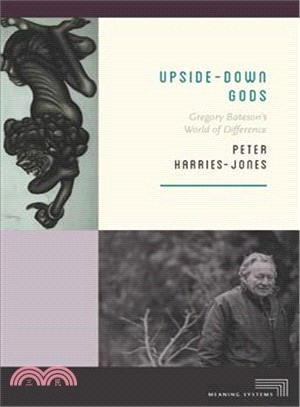
商品簡介
Science's conventional understanding of environment as an inert material resource underlies our unwillingness to acknowledge the military-industrial role in ongoing ecological catastrophes. In a crucial challenge to modern science's exclusive attachment to materialist premises, Bateson reframed culture, psychology, biology, and evolution in terms of feedback and communication, fundamentally altering how we percieve our relationship with nature.
This intellectual biography covers the whole trajectory of Bateson's career, from his first anthropological work alongside Margaret Mead through the afterlife of his work in the development of biosemiotics. Harries-Jones shows how the sum of Bateson's thinking across numerous fields turns our notions of causality upside down, providing a moral divide between sustainable creativity and our perpetration of biocide.
作者簡介
Peter Harries-Jones was born in Oxford, England. He attended secondary school in both England and the United States and universities in the United States, South Africa, and Oxford, U.K. where he obtained his doctorate. Subsequently he was a research officer in the Institute for Social Studies, Zambia where his publications introduced, together with his research group, the subject of social networks into anthropology. His study of social networks led to an interest in communication studies, and systems theory. At the time of political independence in Zambia he was brought in to negotiate a settlement between the African miner's union and the new governing political party, a tension that threatened to break into violent conflict. He taught in the University of Wales, Swansea, University of Khartoum, Sudan, and eventually at York University, Ontario, Canada. Research in the Sudan undertook a study of the grievances of a small group of villages who were threatening to blow up irrigation channels from the Nile River provided as part of a deficient development scheme to grow vegetables. Until the 1980s he remained a specialist in the field of African Studies, both founding and running the African Studies Program at York University. In September 1983, when a situation between the United States and the USSR similar to the 1960's Cuban missile crisis broke out once again, he published for the Royal Society of Canada the Soviet academic assessments of 'nuclear winter' that would follow exchange of nuclear warheads. Gathering material for this assessment led him to an understanding of the importance of models of climate change and from then onwards he directed his research towards 'ecological epistemology' (a term was hardly known at the time). This research culminated in an intellectual biography on Gregory Bateson, drawn from material in the newly catalogued Bateson archives at the University of California, Santa Cruz. After taking early retirement he became one of the founding members of Biosemiotics, a new sub discipline in science that regards Bateson as an important intellectual forebear. He co edited the online internet journalSEED (Semiotics, Evolution, Energy and Development) which was the initial outlet for writing about Biosemiotics before the founding of its own journal. That experience introduced him to many of the current members of that group. He began researching a second book on Bateson in 2005, involving research in a second archive on Gregory Bateson, in the Margaret Mead Collection of the Library of Congress. His first book on Bateson,A Recursive Vision: Ecological Understanding and Gregory Bateson, was short-listed for the best book in social science in Canada in year of publication (1995). The second volume probes Bateson's legacy as one of the 20th centuries great authors, whose holistic approach is reminiscent of Goethe. Bateson pioneered transdisciplinary studies, a realm beyond interdisciplinary studies, in which the study of culture, communication, psychology and biology is treated within a common framework of enquiry, and combines eco-culture with aesthetics. Bateson cites organism- plus- environment as the central unit of study in the 21st century, a theme which is requires reorientation of science from its materialist and technical basis towards a broader framework of enquiry embracing pattern, process and relationship. Harries-Jones believes that Bateson's Gaia-esque concepts of coevolution built on meaningful interaction provides a unifying perspective not discussed in the separate disciplines of anthropology, biology, cultural communication, evolution (e. g. 'selfsh genes'), or psychology.