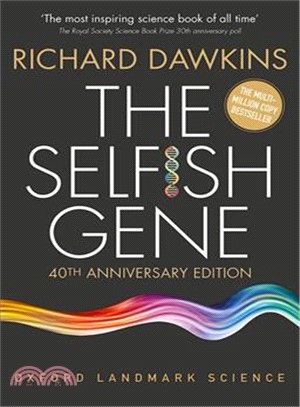
商品簡介
★ 影響全球的科學經典,改寫人類對「進化」的理解
★ 百萬冊暢銷、翻譯超過25種語言
★ 以「基因視角」重新解讀生命與演化
★ 40週年紀念版,全新後記解析當代意義
本書以「基因為中心」的觀點,重新詮釋演化與自然選擇,指出生物只是基因傳遞的載體。作者以清晰且富想像力的敘事,使複雜的生物學理論變得易於理解,並深刻影響現代演化思維。40週年紀念版收錄全新後記,展現其歷久彌新的重要性,是理解生命本質的經典之作。
The million copy international bestseller, critically acclaimed and translated into over 25 languages.
As influential today as when it was first published, The Selfish Gene has become a classic exposition of evolutionary thought. Professor Dawkins articulates a gene's eye view of evolution - a view giving centre stage to these persistent units of information, and in which organisms can be seen as vehicles for their replication. This imaginative, powerful, and stylistically brilliant work not only brought the insights of Neo-Darwinism to a wide audience, but galvanized the biology community, generating much debate and stimulating whole new areas of research. Forty years later, its insights remain as relevant today as on the day it was published.
This 40th anniversary edition includes a new epilogue from the author discussing the continuing relevance of these ideas in evolutionary biology today, as well as the original prefaces and foreword, and extracts from early reviews.
Oxford Landmark Science books are 'must-read' classics of modern science writing which have crystallized big ideas, and shaped the way we think.
作者簡介
Richard Dawkins, Emeritus Fellow of New College, Oxford, is one of the most influential science writers and communicators of our generation. He was the first holder of the Charles Simonyi Chair of the Public Understanding of Science at Oxford, a position he held from 1995 until 2008, and is Emeritus Fellow of New College, Oxford. His bestselling books include The Extended Phenotype (1982) and its sequel The Blind Watchmaker (1986), River Out of Eden (1995), Climbing Mount Improbable (1996), Unweaving the Rainbow (1998), A Devil's Chaplain (2004), The Ancestor's Tale (2004), and The God Delusion (2007). He has won many literary and scientific awards, including the 1987 Royal Society of Literature Award, the 1990 Michael Faraday Award of the Royal Society, the 1994 Nakayama Prize for Human Science, the 1997 International Cosmos Prize, and the Nierenberg Prize for Science in the Public Interest in 2009.