商品簡介
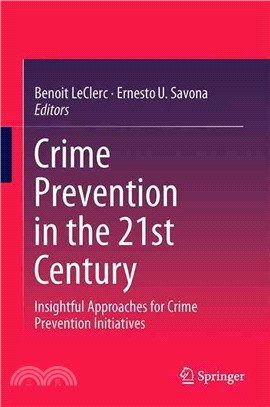
This book brings together a series of contributions made by international experts dedicated to reducing and preventing crime. Although most statistical analyses point to an overall reduction in crime in the past decade, there are a number of specific or emerging crimes on the rise (in particular: cybercrime, identity theft, terrorism, sexual assault, environmental crime, and maritime piracy) that call for new and innovative techniques. This exciting volume is divided into four sections: analysis of past offenders, new analytical tools, legislation, and security techniques. Each section includes one theoretical chapter to introduce and explain the research strategy, and a series of empirical contributions that support the theoretical basis with research evidence. The first section examines past offenders’ perspectives on crime prevention, to see what insight past offenders can offer on future crime prevention. The second section is on promising crime analysis tools designed to investigate crime patterns and guide prevention initiatives. These include (a) crime script analysis (b) crime mapping and spatial analysis (c) social network analysis and (d) agent-based modelling. The focus of the third section is on the innovative use of crime-proofing legislation to facilitate and support crime prevention efforts. The last section is dedicated to technologies of security and situational crime prevention. This work will be of interest to researchers in criminology and criminal justice, with a particular focus on emerging techniques, crime science, situational crime prevention, and technology, and crime legislation as well as related fields such as public policy.?
作者簡介
Benoit Leclerc is a Senior Lecturer in the School of Criminology and Criminal Justice at Griffith University, Brisbane, Australia. He has been involved in research and clinical work with adolescent and adult sex offenders at the Philippe-Pinel Institute of Montreal for 7 years and received his Ph.D. from the Universite of Montreal, Canada. His research interests include script analysis, environmental criminology and situational crime prevention, and sexual offending. He is the lead investigator of a funded project on the study of the effectiveness of situational prevention to prevent sexual offences. Ernesto U. Savona, is Director of TRANSCRIME, Joint Research Centre of the Universita Cattolica del Sacro Cuore and the Universita degli Studi di Trento and Editor-in-Chief of European Journal on Criminal Policy and Research (Springer). Since 2003, he has been professor of Criminology at the Universita Cattolica del Sacro Cuore in Milan. From 1986 to 2002, he was professor of Criminology at the Faculty of Law at the Universita degli Studi di Trento. From 1971 to 1986, he was associate professor at the Faculty of Statistical Sciences at the Universita “La Sapienza” in Rome. He is Past President of the European Society of Criminology (2003/2004) and Chair for the term 2011-2012 of the Global Agenda Council on Organized Crime of the World Economic Forum. Professor Savona is a member of the European Commission experts group on policy needs for data on crime and criminal justice and of the expert group on Firearms. His research interests and key publications include books and articles on organized crime, money laundering and corruption. He has developed for the 6th EU Research Framework Programme the crime-proofing approach aimed at preventing opportunities for crime inadvertently created by regulation.