商品簡介
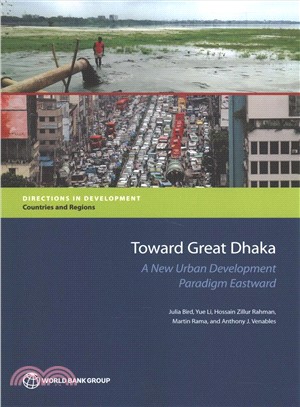
Urbanization is one of the most important drivers of economic and social development. The fact that almost 35 million Bangladeshis will become urban dwellers over the next two decades is excellent news. However, the urbanization process of Bangladesh is now at a crossroads, as it will be much harder for the country to reach upper-middle income status if its cities -- and Dhaka in particular -- do not embark on a new urban development paradigm before the compounded costs of urban congestion and infrastructure retrofitting stall the country's economic and social development.However, Dhaka also has a unique opportunity. Towards its east, there is a vast expanse of land. Most of it is within five kilometers of the most valuable parts of the city but remains mainly rural. Here it is the experience of Shanghai that becomes highly relevant. Much of Shanghai recent success was due to China's strategic approach to the development of East Shanghai (Pudong).This study, as a joint effort by Bangladeshi experts, the University of Oxford, and the World Bank, tries to answer what would be a Pudong-like approach entail in Dhaka's case. By using state-of-the-art modeling techniques, this study simulates population, housing, economic activity, commuting times, transport and trade across the 266 unions that constitute Great Dhaka, taking into account flood vulnerability, traffic congestion and other location conditions. It does so under various scenarios for the development of East Dhaka, but always assessing the implications for the city as a whole. The simulations suggest a strategic approach to the development of East Dhaka, similar in spirit to the development of Pudong, would make Greater Dhaka a much more productive and livable city. And with East Dhaka being the hinge of Bangladesh's emerging north-south and east-west corridors, this greater prosperity is likely to spread. But the opportunity would be to a large extent missed if East Dhaka developed spontaneously, in the same messy way as West Dhaka did after the construction of the western embankment.
作者簡介
The World Bank came into formal existence in 1945 following the international ratification of the Bretton Woods agreements. It is a vital source of financial and technical assistance to developing countries around the world. The organization's activities are focused on education, health, agriculture and rural development, environmental protection, establishing and enforcing regulations, infrastructure development, governance and legal institutions development. The World Bank is made up of two unique development institutions owned by its 185 Member Countries. The International Bank for Reconstruction and Development (IBRD) focuses on middle income and creditworthy poor countries and the International Development Association (IDA), which focuses on the poorest countries in the world.