商品簡介
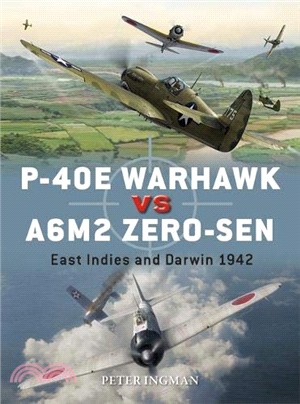
The P-40E Warhawk is often viewed as one of the less successful American fighter designs of World War 2, but in 1942 the aircraft was all that was available to the USAAC in-theatre. Units equipped with the aircraft were duly forced into combat against the deadly A6M2 Zero-sen, which had already earned for itself a near-mythical reputation following its exploits over China and Pearl Harbor. In Javanese and then northern Australian skies during an approximately eight-month period in 1942, an extended air campaign was fought out between the Curtiss and Mitsubishi fighters for air superiority. During this time the P-40Es and the Zero-sens regularly clashed, largely without interference from other fighter types. The pilots of the 3rd Kokutai were an elite group with a hugely successful combat history. Many were veterans of the Sino-Japanese air war, and in early 1942 all had at least 1000 flying hours in their logbooks. When coupled with the extraordinarily fighting machine that was the A6M2 Zero-sen, they would have expected to quickly sweep any opposition from the skies. Their American adversaries, by comparison, began the war without any combat experience. Many were young pilots just out of flight school, but sprinkled among them was a strong cadre of leaders with many years of experience in the peacetime USAAC. The strong American leadership, under Col Paul ‘Squeeze' Wurtsmith, proved a key factor, with the pilots being fast learners who were quick to innovate new tactics. Indeed, in March and April 1942 the IJNAF was surprised by the spirit and tenacity of the Americans, who also had the use of radar to aid in their interceptions. During this period the IJNAF's G4M ‘Bettys' were relatively lightly escorted by the Zero-sens, and several P-40E pilots were able to through to the Japanese bomber formations. The lightly constructed ‘Bettys' proved highly vulnerable to the 0.50-in machine guns of the P-40Es, resulting in a number of them being shot down. However, the Japanese responded by sending in raids at high altitude, where the P-40E's performance was much diminished. Also, the 3rd Kokutai greatly increased the number of fighters assigned to escorting the ‘Bettys', with formations of between 27 and 45 Zero-sens now accompanying the bombers. They would typically be opposed by as many as 50 P-40Es, resulting in some very large aerial battles taking place. In respect to losses, the Japanese ‘won' these engagements, for many more P-40Es were shot down than Zero-sens, and in the latter months of the campaign over northern Australia, no ‘Bettys' were lost at all. However, the American Warhawks provided a potent deterrent that forced the IJNAF to attack from high altitudes, where crews' bombing efficiency was much poorer.