

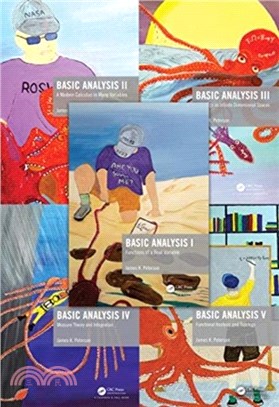
Basic Analysis: Volumes IV is written with the aim of balancing theory and abstraction with clear explanations and arguments, so that students and researchers alike who are from a variety of different areas can follow this text and use it profitably for self-study.
The first volume is designed for students who have completed the usual calculus and ordinary differential equation sequence and a basic course in linear algebra. This is a critical course in the use of abstraction, but is just first volume in a sequence of courses which prepare students to become practicing scientists.
The second volume focuses on differentiation in n-dimensions and important concepts about mappings between finite dimensional Euclidean spaces, such as the inverse and implicit function theorem and change of variable formulae for multidimensional integration. These important topics provide background in important applied and theoretical areas which are no longer covered in mathematical science curricula. Although it follows on from the preceding volume, this is a self-contained book, accessible to undergraduates with a standard course in undergraduate analysis.
The third volume is intended as a first course in abstract linear analysis. This textbook covers metric spaces, normed linear spaces and inner product spaces, along with many other deeper abstract ideas such a completeness, operators and dual spaces. These topics act as an important tool in the development of a mathematically trained scientist.
The fourth volume introduces students to concepts from measure theory and continues their training in the abstract way of looking at the world. This is a most important skill to have when your life''s work will involve quantitative modeling to gain insight into the real world. This text generalizes the notion of integration to a very abstract setting in a variety of ways. We generalize the notion of the length of an interval to the measure of a set and learn how to construct the usual ideas from integration using measures. We discuss carefully the many notions of convergence that measure theory provides.
The final volume introduces graduate students in science with concepts from topology and functional analysis, both linear and nonlinear. It is the fifth book in a series designed to train interested readers how to think properly using mathematical abstractions, and how to use the tools of mathematical analysis in applications.
It is important to realize that the most difficult part of applying mathematical reasoning to a new problem domain is choosing the underlying mathematical framework to use on the problem. Once that choice is made, we have many tools we can use to solve the problem. However, a different choice would open up avenues of analysis from a different, perhaps more productive perspective. In this volume, the nature of these critical choices is discussed using applications involving the immune system and cognition.
Features:
外文書商品之書封,為出版社提供之樣本。實際出貨商品,以出版社所提供之現有版本為主。部份書籍,因出版社供應狀況特殊,匯率將依實際狀況做調整。
無庫存之商品,在您完成訂單程序之後,將以空運的方式為你下單調貨。為了縮短等待的時間,建議您將外文書與其他商品分開下單,以獲得最快的取貨速度,平均調貨時間為1~2個月。
為了保護您的權益,「三民網路書店」提供會員七日商品鑑賞期(收到商品為起始日)。
若要辦理退貨,請在商品鑑賞期內寄回,且商品必須是全新狀態與完整包裝(商品、附件、發票、隨貨贈品等)否則恕不接受退貨。












