




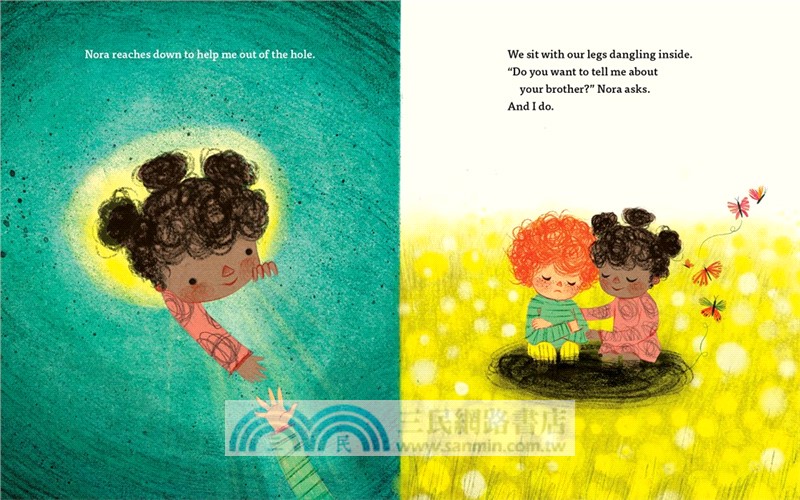


What does it feel like to lose someone you love? For one little boy, it's like he has a hole in his life. It's in the bottom bunk, where his little brother, Matty, used to sleep, and it's on his brother's chair at dinner. It follows him everywhere until the day he decides to really explore it. Inside the hole he confronts his grief--the sadness, the anger, and the truth of how much he misses Matty. His friend is waiting when he climbs out, and when she asks, "Do you want to tell me about your brother?" he's surprised to find that talking about Matty is a comfort--and helps fill his hole with good memories.
-------------
“A family deals with the loss of a child. 'Matty's gone,' and his parents and sibling (who narrates the story) are struggling with the feelings left behind, symbolized here as holes and depicted as scrawled, tight spirals in the middle of characters' chests or on items that Matty once used. The protagonist is trailed everywhere by a hole. . . . With the support of a friend named Nora, the child descends into one of the holes and finds comfort in crying, shouting, and throwing clumps of dirt. Nora invites the narrator to talk more about Matty, and the tale ends with the realization that ‘I don't hate that hole. Not anymore. Because I know I can always fill it with memories of him.' This thought-provoking, poignant look at mourning never explicitly names death but makes concrete a euphemism that could be confusing to children while showing that love for a deceased family member always endures. . . . Striking collage illustrations. . . . A unique and hopeful exploration of grief.” —Kirkus Reviews
“The illustrations, rendered with watercolor washes, colored pencils, and paper collage, add emotional depth to the already effective story. . . . The child expresses the full heaviness of grief. . . . There is no moralizing or promise of things being better, and while the hole has not gone away, there's hope it can hold some of the things Matty loved, like butterflies, elephants, and elaborately choreographed play-sword fights. Well pitched for the child audience, this book is an excellent resource for anyone experiencing loss.” —Booklist
“This tender, deeply empathetic story, narrated by a child grieving the loss of a sibling, offers a moving exploration of grief's many layers. ‘There's a hole in the bottom bunk where my brother, Matty, used to sleep,' the narrator reflects on the first page. The illustrator visualizes this hole as a black scribble drifting throughout the house, a metaphor for grief that captures its persistent, all-encompassing nature. . . . ‘I hate these holes,' the narrator confesses, as classmates react in varying ways: some ignore them, some fail to notice. A friend, Nora, takes a different approach. Curious about the hole, she stays by the protagonist's side as her friend descends into it, spotlighted in the emotional illustrations by a warm yellow light. The story reaches a cathartic turning point. . . . In the quiet that follows, Nora encourages her friend to share stories. These recollections bring them to vivid life, later brightening the mood at the family dinner table and offering a sense of connection and healing amidst their shared loss.” —The Horn Book
“Will resonate with young readers. The language used in this title presents a new way of discussing and understanding grief. The illustrations pair well with the text, evoking the emotion of losing a loved one. . . . The artwork is almost childlike, adding to the appeal. The light source is highlighted on most spreads, which works as a metaphor for the brightness on the other side of a bad situation. Bonilla's latest displays a relevant and optimistic view of how a child might deal with grief. This book tackles a tough topic and will benefit any collection.” —School Library Journal
Lindsay Bonilla (LindsayBonilla.com) is a professional storyteller and author whose previous picture books include The Storyteller, the Parents’ Choice Award winner Polar Bear Island, I Love You with All of My Hearts, and The Note Who Faced the Music. She lives with her husband, two wild and creative kids, and her dog, Blitzen, in North Canton, Ohio.
Brizida Magro (SweetBeyond.com) is an illustrator based in Boulder, Colorado, where she teaches illustration at Rocky Mountain College of Art and Design. She also illustrated Gift & Box by Ellen Mayer, Saturday at the Food Pantry by Diane O’Neill, and Let Me Call You Sweetheart by Mary Lee Donovan. She is passionate about rock climbing, wandering the world, and bringing stories to life.
外文書商品之書封,為出版社提供之樣本。實際出貨商品,以出版社所提供之現有版本為主。部份書籍,因出版社供應狀況特殊,匯率將依實際狀況做調整。
無庫存之商品,在您完成訂單程序之後,將以空運的方式為你下單調貨。為了縮短等待的時間,建議您將外文書與其他商品分開下單,以獲得最快的取貨速度,平均調貨時間為1~2個月。
為了保護您的權益,「三民網路書店」提供會員七日商品鑑賞期(收到商品為起始日)。
若要辦理退貨,請在商品鑑賞期內寄回,且商品必須是全新狀態與完整包裝(商品、附件、發票、隨貨贈品等)否則恕不接受退貨。












