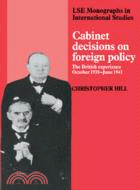
Although Parliament is the principal source of authority in the British political system, it is the Cabinet which stands at the pinnacle of government. Yet what actually happens at Cabinet meetings? How are decisions made, particularly in the arena of foreign policy? Such questions have hitherto been largely overlooked by both historians and political scientists. In this book, Dr Christopher Hill presents a detailed case-study of the British government and foreign policy, during the dramatic period from the Munich Conference of 1938 to the German invasion of the Soviet Union three years later. Using extensive archival material, he examines how far the strong personalities of Neville Chamberlain and Winston Churchill respectively were really able to dominate their Cabinets in an area of policy where Prime Ministers have traditionally been supposed to exercise considerable freedom. This analysis concentrates on six decisions that were of key importance in committing Britain to the war wh
若需訂購本書,請電洽客服 02-25006600[分機130、131]。