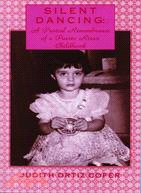
In this collection of essays woven with poems and folklore, Judith Ortiz Cofer tells the story of how she became a poet and writer and explores her love of words, her discovery of the magic of languag
A collection of short stories, with poems and essays, addresses the theme of straddling two cultures as do the offspring of Hispanic parents living in the United States
Reviewing her novel, The Line of the Sun, the New York Times Book Review hailed Judith Ortiz Cofer as "a writer of authentic gifts, with a genuine and important story to tell." Those gifts are on abun
“I am learning the alchemy of grief—how it must be carefully measured and doled out, inflicted—but I have not yet mastered this art,” writes Judith Ortiz Cofer in The Cruel Country. This richly textur
Rita is exiled to Puerto Rico for a summer with her grandparents after her parents catch her with a boy. Luis sits atop a six-foot mountain of hubcaps in his father's junkyard, working off a sentence
Through her beautifully lyrical writing, Judith Ortiz Cofer tells us ofthe women's lives that entangled with hers in El Building in Paterson,New Jersey.
Set in the 1950s and 1960s, The Line of the Sun moves from a rural Puerto Rican village to a tough immigrant housing project in New Jersey, telling the story of a Hispanic family's struggle to become
A collection of writings by the poet, novelist, and essayist recalling her childhood spent shuttling between the land of her birth and the family home in New Jersey.
"There is much in this book to inspire any writer to seek more in his or her own writing: to pay attention to sounds, smells, people, and dialogue. Because Judith's voice is strong, offering such a re
Judith Ortiz Cofer’s third volume of poetry collects thirty-four poems written over the course of many years. In places as stark as a New Jersey barrio or fabled as the island home of Penelope
La nina seria, the serious child. That’s how Consuelo’s mother has cast her pensive, book-loving daughter, while Consuelo’s younger sister, Mili, is seen as vivacious—a ray of
Cofer confronts cultural legacy and a woman's desire “to be released from rituals” in her poetic dialectic of survival. Cultural icons, customs and rites of passage take root in an imagery that is lus
Maria is a girl caught between two worlds: Puerto Rico, where she was born, and New York, where she now lives in a basement apartment in the barrio. While her mother remains on the island, Maria lives