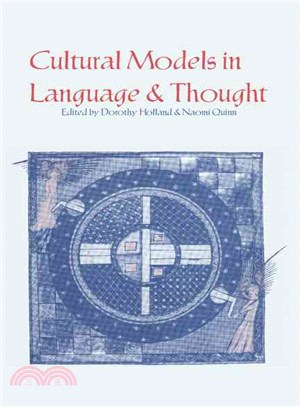
The papers in this volume, a multidisciplinary collaboration of anthropologists, linguists, and psychologists, explore the ways in which cultural knowledge is organized and used in everyday language and understanding. Employing a variety of methods, which rely heavily on linguistic data, the authors offer analyses of domains of knowledge ranging across the physical, social, and psychological worlds, and reveal the importance of tacit, presupposed knowledge in the conduct of everyday life. The authors argue that cultural knowledge is organized in 'cultural models' - storylike chains of prototypical events that unfold in simplified worlds - and explore the nature and role of these models. They demonstrate that cultural knowledge may take either proposition-schematic or image-schematic form, each enabling the performance of different kinds of cognitive tasks. Metaphor and metonymy are shown to have special roles in the construction of cultural models. The authors also demonstrates that so