商品簡介
"On 18 November 2004, Hunter College told Professor Bernadette McCauley to cease all her research' she was under investigation. In a letter sent by certified mail both to McCauley's home and office, two professors warned her that she had put the entire City University of New york at risk, and that her actions would be reported to the federal government. What dreadful crime had McCauley committed? She had obtained the phone numbers of foure nuns who had grown up in Washington Heights and who might give advice to some history students researching the neighborhood. McCauley thought she was just arranging some casual conversations. To Hunter College's Committee for the Protection of Human Research Participants, however, McCauley's potential interaction with the nuns might be `research which involves human subjects.' By failing to seek permission to conduct it, McCauley had committed as serious academic offense. The committee began to investigate not only McCauley's contact with the nuns, but also her use of archival documents while researching a book. McCauley thought this was absurd, and she hired a lawyer to resist the pressure. But on being told her job was at risk, she gave the committee the information it wanted. After six months, it concluded that her work was not subject to review after all.
"McCauley's case was extreme, but it Illustrates the powers that institutional review boards (IRBs), such as Hunter's committee, can wield over almost every scholar in the United States who wants to interview, survey or observe people, or to train students to do so."---from the Introduction
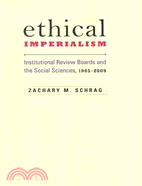
University researchers in the United States seeking to observe, survey, or interview people are required first to complete ethical training courses and to submit their proposals to an institutional review board (IRB). Under current rules, IRBs have the power to deny funding, degrees, or promotion if their recommended modifications to scholars' proposals are not followed. This valume explains how this system of regulation arose and discusses it chilling effects on research in the social sciences adn humanities.
Zachary M. Scharg drwws on original reserch and interviews with the key shapers of the institutional review board regime to raise important points about the effect of the IRB process on scholarship. He explores the origins and the application of these regulations and analyzes how the rules---initially crafted to protect the health and privacy of human medical subjects---can limit even casual scholarly interactions such as a humanist interviewing a poet about his or her writing. In assessing the issue, schrag argues that biomedical reserachers and bioethicists repeatedly excluded social scientists from rule making and ignored the existing ethical traditions in nonmedical fields. Ultimately, he contends, IRBs not only threaten to polarize medical and social scientists, they also create an atmosphere wherein certain types of academics can impede and even silence others.
The first work to document the troubled emergence of today's system of regulating scholarly research, Ethical Imperialism illuminates the problems caused by simple, universal rule making in academic and professional research. This short, smart analysis will engage scholars across academia.
作者簡介
Zachary M. Schrag, an associate professor of history at George Mason University, is the author of The Great Society subway: A History of the Washington Metro, also Published by Johns Hopkins.