商品簡介
"This is a well-written book that will be particularly useful for analysts who are not PhD statisticians. Enders provides a much-needed overview and explication of the current technical literature on missing data. The book should become a popular text for applied methodologists."
"A needed and valuable addition to the literature on missing data. The simulations are excellent and are a clear strength of the book."
"Enders provides useful reminders of what we need to know and why. I appreciated the interpretation of formulas, terms, and output. This book provides comprehensive and vital information in an easy-to-consume style."
"I would certainly recommend this book to anybody who deals with missing data at any level. I have no doubt that this book will serve as a solid reference for quantitative social and behavioral scientists."
"I would highly recommend this book to colleagues and will require it in my advanced graduate courses on longitudinal data analysis."
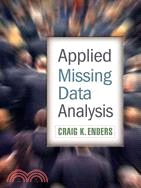
Walking Readers Step By Step Through Complex Concepts, This Book Translates Missing Data techniques into something that applied researchers and graduate students can understand and utilize in their own research. Enders explains the rationale and procedural details for maximum likelihood estimation, Bayesian estimation, multiple imputation, and models for handling missing not at random (MNAR) data. Easy-to-follow examples and small simulated data sets illustrate the techniques and clarify the underlying principles. The companion website (www.appliedmissingdata.com) includes data files and syntax for the examples in the book as well as up-to-date information on software. The book is accessible to substantive researchers while providing a level of detail that will satisfy quantitative specialists.
作者簡介
Bengt Muthen, Professor Emeritus, University of California, Los Angeles
Alan C. Acock, Distinguished Professor and Knudson Chair in Family Research, Department of Human Development and Family Sciences, Oregon State University
Julia McQuillan, Director, Bureau of Sociological Research, and Department of Sociology, University of Nebraska-Lincoln
Hakan Demirtas, School of Public Health, University of Illinois at Chicago
Scott M. Hofer, Professor and Mohr Chair in Adult Development and Aging, Department of Psychology, University of Victoria, Canada
Craig K. Enders is Associate Professor in the Quantitative Psychology concentration in the Department of Psychology at Arizona State University.