商品簡介
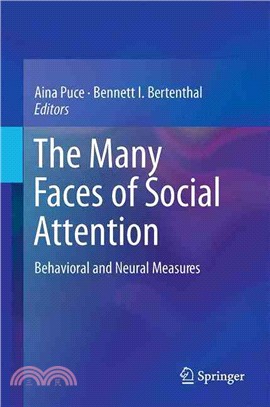
This book aims to provide a comprehensive overview of the area of social attention. It examines the brain-behavioral bases of social attention from complementary perspectives of different fields, including primate research, clinical and healthy adults findings, developmental studies and the neural bases of social attention. These subjects are each explored in their own specific chapters. Additionally, the volume is book-ended by an introductory chapter that sets the scene for the field as a whole, and a concluding chapter that highlights outstanding questions and potential future directions for research. Social attention is fundamental to the development of effective human non-verbal and verbal communication. We monitor the eyes, faces, hands and postures of others in order to glean what they are attending to, or are interested in, and we notice when they are, or are no longer, looking at us in a conversation. It is something we have in common with non-human primates. Beginning with infants’ very early sensitivity to deictic cues, such as eye gaze and pointing, skills such as joint attention and theory of mind start to develop. By examining issues such as human development, and normal and diseased human brain function, as well as non-human primate social attention, The Many Faces of Social Attention is a concise, but complete, reference source for recent literature on social attention. It will be of great interest to researchers in social neuroscience, social psychology, developmental, psychology, social cognition, vision research and clinical psychology.
作者簡介
Aina Puce is a social/cognitive neuroscientist with a long-standing interest in the neural bases of human face perception and more recently, non-verbal communication. Puce was one of the first researchers to study neurophysiological responses to dynamic human faces in the mature human brain. Her studies have used behavior paired with invasive and non-invasive EEG, MEG, and fMRI to explore how the brain perceives and processes dynamic human faces under different social contexts.Bennett I. Bertenthal is a developmental cognitive neuroscientist with 35 years of experience studying the perception and production of human actions in infants and adults. He was a pioneer in the study of the development of infants’ perception and discrimination of biological motions, and more recently has focused on how infants’ and adults’ social attention to face orientation, eye gaze, pointing, and manual actions contributes to their understanding the social goals of others. His research combines eye tracking, EEG, response times, and motion analysis to study action understanding in real and developmental time.